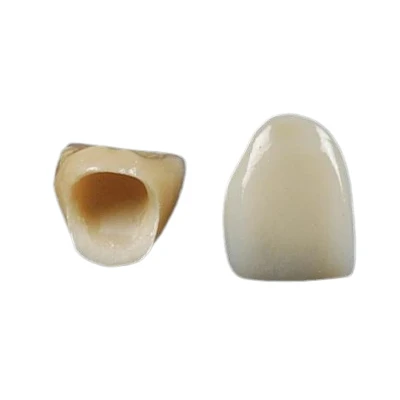
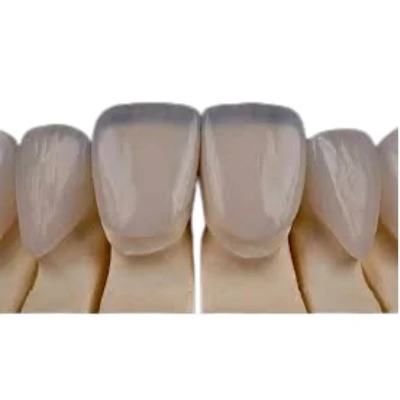
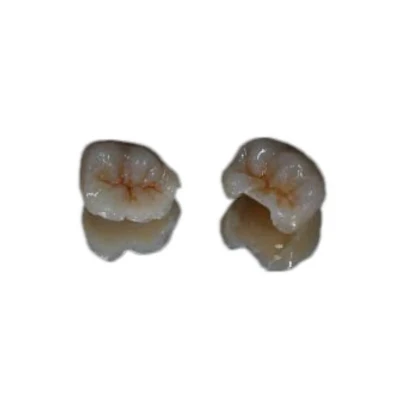


E.max crowns require enough restorative space to maintain ceramic strength, contour, fit, and esthetics. For most full-coverage cases, preparation should create even anatomical reduction, a clear chamfer or rounded shoulder, and smooth internal geometry without sharp angles. Posterior crowns generally need about 1.5–2.0 mm of occlusal reduction, while anterior crowns usually require about 1.0–1.5 mm facial and lingual reduction with 1.5–2.0 mm incisally.
Thickness alone, however, does not determine success. Preparation geometry, occlusion, margin design, scanning quality, and the final restoration design all matter.

How Thick Should an E.max Crown Be?
IPS e.max CAD lithium disilicate glass-ceramic is used for crowns and other all-ceramic restorations where a combination of strength and esthetics is required. Its preparation requirements vary according to restoration type and location.
For full-coverage E.max crowns, the following dimensions provide a practical starting point.
|
Preparation area |
Typical preparation guideline |
|
Posterior occlusal reduction |
1.5–2.0 mm |
|
Posterior axial reduction |
About 1.0–1.5 mm |
|
Anterior facial reduction |
About 1.0–1.5 mm |
|
Anterior lingual/palatal reduction |
About 1.0–1.5 mm |
|
Anterior incisal reduction |
About 1.5–2.0 mm |
|
Crown finish line |
About 1.0 mm |
|
Practical posterior occlusal target |
About 2.0 mm in many cases |
These figures describe preparation space, not a universal final thickness that applies to every point of every E.max crown.
A posterior crown, for example, may be prepared with 1.5–2.0 mm of occlusal reduction while the actual ceramic thickness varies across the cusps, central fossa, grooves, and axial walls. The restoration still needs enough material in the areas that carry functional load.
For that reason, E.max crown thickness should always be evaluated together with preparation geometry and occlusal clearance.
E.max Crown Thickness vs. Tooth Reduction: What Is the Difference?
Three measurements are often mixed together when discussing E.max crown preparation.
Tooth reduction is the amount of natural tooth structure removed during preparation.
Restorative clearance is the space available between the prepared tooth and the opposing or adjacent dentition.
Material thickness is the actual thickness of lithium disilicate in the finished restoration.
They are related, but they are not interchangeable.
For example, approximately 1.5 mm of posterior occlusal material may be required in a functional area, while the clinician may prepare closer to 1.5–2.0 mm to create enough space for anatomy, occlusal design, cement space, and manufacturing tolerances.
The same principle applies to anterior crowns. A preparation may have 1.5 mm of incisal reduction, but the final restoration does not necessarily have exactly 1.5 mm of ceramic at every point. Layering, contour, stump position, and restoration design can change the final dimensions.
This distinction is particularly important when a laboratory reports insufficient clearance. The solution should not automatically be to make the crown thinner.
Posterior E.max Crown Preparation Requirements
Posterior E.max crowns are exposed to higher functional loading, so occlusal and axial space must be controlled carefully.
A commonly used range for posterior E.max crown occlusal reduction is 1.5–2.0 mm. In many full-coverage posterior cases, 2.0 mm is a useful practical target because it provides adequate space for the restoration while remaining easy to verify clinically.
Axial reduction is commonly around 1.0–1.5 mm, with adequate bulk maintained around functional areas.
The important point is that occlusal reduction must follow the original tooth anatomy.
A 2 mm reduction does not mean cutting a flat table 2 mm below the original occlusal surface. The central fossa, cusps, developmental grooves, and functional cusp bevel should still follow a smooth anatomical form.
If the central fossa is under-reduced, the restoration may become locally thin exactly where an opposing cusp makes centric contact. A similar problem can occur in buccal or lingual grooves that provide clearance during eccentric movements.
The functional cusp bevel also needs a smooth transition. Abrupt planes or sharp line angles can concentrate stress in an all-ceramic restoration.
For posterior E.max crown preparation, the practical goals are straightforward:
- Maintain about 1.5–2.0 mm of occlusal space.
- Provide approximately 1.0–1.5 mm of axial reduction.
- Follow the natural occlusal anatomy.
- Round internal line angles.
- Avoid sharp transitions and unsupported tooth structure.
- Create a clear, smooth finish line of about 1.0 mm.
Adequate posterior clearance is important, but uniform anatomical reduction is just as important as the numerical depth.
Anterior E.max Crown Preparation Requirements
Anterior E.max crowns have different functional and esthetic requirements from posterior crowns. They still need adequate ceramic bulk, but the preparation must also create space for natural contour, translucency, shade development, and, where used, layering porcelain.
A practical anterior preparation range is:
|
Area |
Typical reduction |
|
Facial |
About 1.0–1.5 mm |
|
Lingual/palatal |
About 1.0–1.5 mm |
|
Incisal |
About 1.5–2.0 mm |
|
Finish line |
About 1.0 mm |
The facial surface should generally be prepared anatomically rather than as one flat plane. A three-plane reduction that follows the cervical, middle, and incisal contours helps create more even restorative space.
This matters for both strength and esthetics.
If the facial surface is under-reduced, the technician may have to choose between an over-contoured crown and insufficient ceramic thickness. If it is aggressively over-reduced, healthy tooth structure is sacrificed without a clear restorative benefit.
Incisal space also deserves particular attention. The material needs enough bulk to support the planned contour and withstand functional loading. Layered anterior restorations may require more space than a purely monolithic design because room must be provided for both the lithium disilicate structure and esthetic ceramic.
Material thickness can also influence translucency, masking ability, and the final shade. Uniform reduction therefore helps the laboratory manage both structural and esthetic objectives more predictably.

Margin Design, Taper, and Internal Geometry for E.max Crowns
Millimeter values are only part of an E.max crown preparation. Margin shape, convergence, and internal geometry directly affect ceramic support, retention, scanning, and milling.
Heavy Chamfer vs. Rounded Shoulder
A heavy chamfer or rounded shoulder is commonly used for E.max crowns. A finish line of approximately 1.0 mm provides room for ceramic at the margin while keeping the preparation clearly defined. For a broader comparison of preparation designs, see this guide to dental crown margin design, including chamfer and shoulder margins.
The internal aspect should be rounded.
Sharp 90-degree internal shoulders should be avoided because they create stress concentration points in the ceramic. Feather-edge margins are also unsuitable in many E.max crown preparations because they provide limited ceramic bulk and can be difficult to identify accurately during digital scanning and design.
The opposite problem is making the margin unnecessarily wide.
An excessively broad shoulder requires more axial reduction and removes additional natural tooth structure. It can also become harder to keep the finish line smooth and continuous. The objective is adequate ceramic support, not the widest possible margin.
Taper and Preparation Height
The preparation needs enough convergence to allow seating without becoming excessively tapered.
The reference materials place practical convergence values within a relatively narrow range, with about 6 degrees serving as a useful clinical target. More important than hitting an exact number is avoiding excessive taper that unnecessarily reduces mechanical retention.
Preparation height also matters. For conventional or self-adhesive cementation, approximately 4 mm or more of axial wall height provides useful mechanical retention when the overall preparation form is appropriate.
Why Rounded Internal Angles Matter
Sharp internal geometry concentrates stress within ceramic. It can also create manufacturing problems because milling tools have a finite diameter and cannot reproduce infinitely sharp internal features.
Smooth transitions therefore benefit both the restoration and the CAD/CAM process.
What Happens If There Is Not Enough-or Too Much-Tooth Reduction?
Both under-reduction and over-reduction create problems.
Insufficient Occlusal or Axial Clearance
When restorative space is inadequate, the laboratory may face several compromises:
- Local areas of insufficient E.max thickness
- Over-contoured crown anatomy
- Reduced occlusal clearance
- More aggressive adjustment during manufacturing or chairside delivery
- Greater risk of creating a weak functional area
This is especially important on posterior occlusal surfaces. A crown can have adequate space over one cusp while remaining critically thin in the central fossa or functional cusp region. Research on lithium disilicate crown thickness and fracture resistance is useful when evaluating how material thickness influences mechanical behavior.
Making the restoration thinner is not automatically the correct solution.
The case may need reassessment of the preparation, opposing dentition, occlusal design, restoration type, or material selection. If the deficiency is significant, dentist-laboratory communication before fabrication is preferable to silently compensating during design.
Why Over-Preparation Is Also a Problem
E.max needs sufficient space, but more reduction is not automatically better.
Unnecessarily deep axial preparation or an excessively wide margin removes healthy tooth structure without guaranteeing a stronger restoration. It can also make the finish line harder to control.
The correct objective is adequate, even restorative space with conservative preservation of sound tooth structure.
How Preparation Design Affects Digital Scanning and CAD/CAM Milling
A preparation may satisfy the nominal reduction numbers and still be difficult to manufacture.
A modern CAD/CAM dental workflow depends on a preparation that can be captured accurately, designed predictably, and milled with available tooling.
The finish line should be clearly visible and continuous. Marginal lips, irregular "ski-slope" shapes, or unsupported projections can make optical scanning more difficult. The quality of the preparation is therefore closely linked to what a dental lab needs from an intraoral scan for predictable crown design.
Undercuts create another problem. During CAD design, undercut areas may need to be blocked out to establish a path of insertion. This can reduce available restorative space in the affected area and create unwanted variations in thickness.
Milling geometry matters as well. Very sharp internal corners or narrow incisal features cannot always be reproduced accurately because the milling bur has a physical diameter. Rounded internal geometry and adequate feature size improve tool access and reduce unnecessary manufacturing compromises.
Before an E.max crown enters production, a digital dental laboratory should therefore review more than the headline clearance figure. Important checks include:
- Margin visibility and continuity
- Occlusal and axial clearance
- Undercuts
- Path of insertion
- Internal line angles
- Minimum material thickness
- Contact and occlusal design
- Overall scan quality
A well-prepared tooth is easier to scan, easier to design, and easier to mill accurately.
When Do E.max Preparation Requirements Need Extra Consideration?
The same numerical preparation guideline should not be applied blindly to every patient.
Bruxism and Heavy Occlusion
Heavy occlusion, clenching, and bruxism increase functional demands on a restoration. Evidence concerning bruxism and ceramic restoration fracture risk supports treating parafunctional loading as an important case-selection factor rather than relying on thickness alone.
In these cases, simply increasing E.max thickness does not solve every risk. Occlusal scheme, restoration location, remaining tooth structure, preparation geometry, and material selection all require closer evaluation. Understanding the causes of high occlusion in dental crowns can also help reduce unnecessary chairside adjustment and remake risk.
For some high-load cases, zirconia or another restorative approach may be more appropriate than lithium disilicate. A broader E.max vs. zirconia comparison can help when material selection is uncertain.
Monolithic vs. Layered E.max
Monolithic E.max crowns use lithium disilicate throughout the main restoration and generally preserve more of the strength of the core material.
Layered E.max restorations combine a lithium disilicate substructure with an esthetic veneering ceramic. The overall restoration can then be influenced by the weaker veneering layer, particularly in areas exposed to flexural stress.
This is one reason posterior cases are often designed monolithically when strength is the priority, while layered designs may be selected in the esthetic zone when additional characterization is required.
The preparation must provide space for the restoration actually being prescribed, not just for the material name "E.max." For broader case-selection guidance, see when dentists should use E.max and where its limitations matter.
Cementation and Retention
E.max restorations may be bonded adhesively, and some crown preparations may also be suitable for conventional or self-adhesive cementation depending on the clinical situation and restoration design.
Preparation height, taper, and resistance form still matter. A severely over-tapered preparation should not rely on cement alone to compensate for poor geometry.
Cementation strategy should therefore be considered together with preparation design rather than as a separate final step.

Conclusion
E.max crown preparation is most predictable when the clinician creates sufficient, even restorative space while preserving natural tooth structure. For most posterior full-coverage cases, about 1.5–2.0 mm of occlusal reduction is a useful working range; anterior crowns generally require about 1.0–1.5 mm facial and lingual reduction with 1.5–2.0 mm incisally. Clear margins, rounded internal angles, anatomical reduction, and adequate scan and milling access are equally important.
ADS Dental Laboratory Ltd provides digital E.max crown production and dental laboratory outsourcing support for dentists and dental laboratories. If you have a case with limited clearance, uncertain margin geometry, or a digital scan that needs laboratory review, contact ADS to discuss the preparation and restoration design before production.
Frequently Asked Questions About E.max Crown Thickness and Preparation
What is the minimum thickness for an E.max crown?
There is no single thickness that applies to every surface and every E.max restoration. The reference data used for this guide places posterior occlusal material around 1.5 mm in many crown applications, with approximately 1.0 mm in some other crown areas. The required preparation space may be greater because tooth reduction and final ceramic thickness are not identical measurements.
How much occlusal reduction does a posterior E.max crown need?
A commonly used range is 1.5–2.0 mm. About 2.0 mm is a practical target for many full-coverage posterior preparations when clinical conditions allow.
The reduction should follow the anatomy of the tooth rather than producing a flat occlusal table.
Is a chamfer or shoulder better for E.max?
Both a well-defined heavy chamfer and a rounded shoulder can provide appropriate support for an E.max crown. The finish line is commonly around 1.0 mm and should be smooth, continuous, and internally rounded.
Sharp shoulders and poorly defined feather-edge margins should be avoided.
Can an E.max crown be made with only 1 mm of occlusal space?
One millimeter may be insufficient for a conventional full-coverage posterior E.max crown in an area of functional loading, based on the preparation ranges discussed above.
The laboratory should evaluate where the limited space occurs, the restoration design, the occlusion, and whether another preparation or material strategy would be more predictable.
Is E.max suitable for patients who grind their teeth?
Bruxism and heavy occlusal loading require careful case selection. Increasing crown thickness alone does not eliminate the mechanical risk. Occlusion, restoration location, preparation design, and alternative materials such as zirconia may need to be considered.