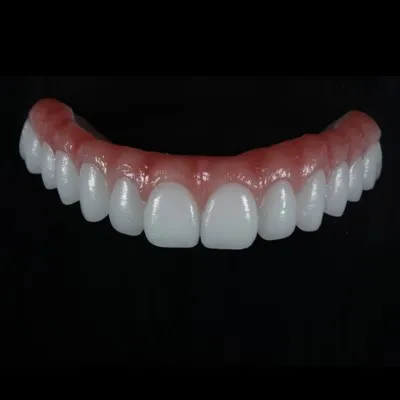
Zirconia, lithium disilicate, and polymethyl methacrylate (PMMA) are often discussed together because all three are used in digital dental restoration workflows. However, they do not solve the same problem.
Zirconia is a high-strength ceramic used in situations where load-bearing capacity and long-term durability are required. Lithium disilicate is a glass-ceramic suited for cases where esthetics, translucency, and adhesive bonding performance are the top priorities. PMMA, on the other hand, is an acrylic resin primarily used for temporary restorations, try-in restorations, and diagnostic restorations.
So, which material is the best? To answer that question, we first need to know what the case requires the material to do. This distinction is crucial. A posterior bridge, an anterior veneer, an implant provisional, and a full-arch prototype should not follow the same material selection logic.

Material Selection Starts with the Indication, Not the Material
Dental restoration material selection should begin with the clinical indication. In simple terms, an indication means the specific use case: crown, bridge, veneer, implant restoration, temporary restoration, full-arch case, or diagnostic try-in.
A material that works well for one indication can fail in another.
For example, lithium disilicate can be an excellent choice for an anterior veneer because it offers natural translucency and reliable bonding. The same material would be a poor routine choice for a long-span posterior bridge under heavy occlusal load.
PMMA is another common example. It is valuable in full-arch provisional workflows because it allows the dentist and lab to test esthetics, bite, phonetics, and vertical dimension before producing the final zirconia restoration. But that does not make PMMA a final ceramic substitute.
Before choosing zirconia, lithium disilicate, or PMMA, check these factors:
- Is the restoration anterior or posterior?
- Is it temporary or final?
- Is it tooth-supported or implant-supported?
- Is it a single crown, bridge, veneer, or full-arch case?
- Is the patient a bruxer or high-load patient?
- Is there enough restorative space?
- Is reliable bonding possible?
- Is the priority strength, esthetics, speed, cost control, or treatment verification?
A good material choice is not based on habit. It is based on the risk profile of the case.
Quick Comparison: Zirconia vs Lithium Disilicate vs PMMA
The table below gives a practical comparison for dental labs, dentists, and outsourcing partners.
|
Material |
Main Advantage |
Esthetics |
Strength |
Bonding / Cementation |
Best Used For |
Main Limitation |
|
Zirconia |
High strength and long-term durability |
Moderate to good, depending on type |
High; many dental zirconia grades are far stronger than glass ceramics |
Can be conventionally cemented or bonded with proper protocol |
Posterior crowns, bridges, implant restorations, full-arch final cases |
Esthetics vary by zirconia type |
|
Lithium Disilicate |
Natural translucency and adhesive bonding |
Excellent |
Moderate compared with zirconia |
Etchable glass ceramic; usually resin bonded |
Veneers, anterior crowns, inlays, onlays, selected single crowns |
Not ideal for most long-span or high-load cases |
|
PMMA |
Fast, adjustable, cost-effective |
Good for provisional use |
Lower than ceramics |
Mainly temporary or provisional use |
Temporaries, try-ins, implant provisionals, full-arch prototypes |
Not designed as a long-term final restoration |
Typical material data varies by brand, generation, translucency level, and processing protocol. As a general working reference, high-strength zirconia is often specified in the hundreds to over 1,000 MPa flexural strength range, while lithium disilicate is commonly specified around the mid-hundreds MPa range. PMMA is much lower and should be understood as a resin provisional material, not a load-bearing final ceramic.
The numbers matter, but they do not replace case judgment.
Zirconia: Best for Strength, Posterior Load, and Long-Term Final Restorations
Zirconia, or zirconium dioxide, is a polycrystalline ceramic widely used in CAD/CAM dental lab production. CAD/CAM means computer-aided design and computer-aided manufacturing, the standard workflow for designing and milling restorations from digital files.
Zirconia is usually the safer choice when the restoration must resist high occlusal force over time.
When Zirconia Is Usually the Better Choice
Zirconia is commonly selected for:
- Posterior single crowns
- Multi-unit bridges
- Long-span bridges
- Implant crowns and implant bridges
- Full-contour crowns
- Full-arch final restorations
- Bruxism or high-load cases
- Cases with limited tolerance for ceramic fracture
A typical industrial case would be a three-unit posterior bridge for a molar region. The connector design, pontic span, occlusal contacts, and available vertical space all create load risk. In this type of case, zirconia is usually more predictable than lithium disilicate.
Implant restorations are another common area for zirconia. Implant-supported crowns and bridges do not have the same periodontal ligament cushioning as natural teeth. Occlusal control becomes more demanding. Zirconia gives the lab more confidence when strength and long-term stability are the main concerns.
What to Watch For with Zirconia
Zirconia is not one single material.
Traditional high-strength zirconia is different from high-translucency zirconia. Multilayer zirconia is different again. Modern multilayer zirconia uses shade transitions from the cervical area toward the incisal area, helping the restoration look less flat and reducing the need for heavy manual staining.
That helps, but it does not remove the need for material judgment.
A highly translucent zirconia may look better in an anterior case, but it may not be the best option for a long-span bridge or a heavy bruxer. A very strong zirconia may work well in a posterior bridge, but it may not deliver the enamel-like optical effect expected in a demanding anterior esthetic case.
Zirconia outcomes also depend heavily on lab control:
- CAD design and connector dimensions
- Minimum thickness
- Milling accuracy
- Sintering temperature and cycle
- Surface finishing and polishing
- Occlusal adjustment strategy
Poorly polished zirconia can create problems at the opposing dentition. Thin or poorly designed connectors can create fracture risk even if the material itself is strong.
Zirconia is powerful, but it is not automatic. The right zirconia type and the right design matter as much as the material name.

Lithium Disilicate: Best for Esthetic and Adhesive Single Restorations
Lithium disilicate is a high-strength glass-ceramic used for restorations that need natural translucency, light transmission, and adhesive bonding. Many dentists know it through systems such as IPS e.max, though the category is broader than one brand.
Its main strength is not only appearance.
Lithium disilicate is an etchable ceramic. That means the internal surface can be treated for resin bonding, giving it strong clinical value in veneers, inlays, onlays, and selected crown cases where adhesive protocols are well controlled.
When Lithium Disilicate Works Well
Lithium disilicate is commonly used for:
- Veneers
- Anterior crowns
- Inlays
- Onlays
- Partial coverage restorations
- Selected premolar or molar single crowns
- Cases where bonding is reliable
- Cases where natural shade integration matters
For an anterior veneer case, lithium disilicate is often the more natural choice than zirconia. The material can reproduce enamel-like translucency and blend with adjacent teeth, especially when the preparation design, stump shade, and bonding protocol are favorable.
It is also useful for conservative restorations. Inlays and onlays often depend on bonding rather than mechanical retention alone. In those cases, lithium disilicate gives the clinician a good combination of esthetics and adhesive performance.
Where Lithium Disilicate Has Limits
Lithium disilicate should not be selected only because it looks good.
It is generally weaker than many zirconia materials, so it is not the routine answer for long-span bridges, heavy posterior load, or patients with strong parafunctional habits. It also needs enough material thickness and a preparation design that supports the restoration.
Common risk factors include:
- Insufficient occlusal clearance
- Poor bonding isolation
- Thin ceramic in functional areas
- Long-span bridge design
- Bruxism or heavy occlusion
- Limited retention form
A posterior single crown may still be possible with lithium disilicate in selected cases. But if the bite is heavy, space is limited, or bonding conditions are poor, zirconia often becomes the more practical option.
Lithium disilicate is best when the case gives it the conditions it needs: enough space, good bonding, and a clear esthetic reason.
PMMA: Best for Temporary, Provisional, and Diagnostic Restorations
PMMA stands for polymethyl methacrylate. In digital dentistry, PMMA is commonly milled for temporary crowns, provisional bridges, implant provisionals, try-ins, and full-arch prototypes.
PMMA should not be treated as a cheap version of zirconia or lithium disilicate. It has a different role.
Its value is speed, adjustability, cost control, and treatment verification.
Common Uses of PMMA in Digital Restorative Workflows
PMMA is often used for:
- Temporary crowns
- Provisional bridges
- Implant provisionals
- Full-arch prototypes
- Smile design mock-ups
- Try-in restorations
- Occlusal verification
- Vertical dimension testing
- Immediate or transitional implant restorations
A common full-arch workflow shows PMMA's value clearly. Before milling the final zirconia bridge, the lab can produce a PMMA prototype. The dentist can check lip support, midline, incisal edge position, phonetics, bite, and patient comfort.
That step can prevent expensive remakes.
For implant provisionals, PMMA can also help shape soft tissue and test emergence profile before the final restoration. In these cases, PMMA is not just a temporary material. It is a diagnostic tool.
Why PMMA Should Not Be Used Like a Final Ceramic
PMMA has limits.
It is more prone to wear, staining, plaque accumulation, and fracture than ceramic materials. It is easier to adjust, but that same property means it cannot provide the same long-term performance as zirconia or lithium disilicate in final fixed restorations.
Reinforced PMMA options can improve certain properties, but in fixed restorative workflows, PMMA is still mainly a provisional or diagnostic material.
If a case needs long-term load-bearing strength, PMMA is not the final answer. If the case needs a safe test phase before final production, PMMA can be very useful.
Choosing the Right Material by Clinical Indication
Most dentists and labs do not need a long material lecture. They need to know what to choose for the case in front of them.
The table below gives a practical indication-based guide.
|
Clinical Indication |
Usually Recommended Material |
Why |
|
Posterior single crown |
Zirconia / selected lithium disilicate |
Zirconia handles higher load; lithium disilicate may work when bonding, thickness, and occlusion are favorable |
|
Anterior crown |
Lithium disilicate / translucent zirconia |
Lithium disilicate offers stronger translucency; translucent zirconia may help when masking or strength is needed |
|
Veneer |
Lithium disilicate |
Strong esthetics and adhesive bonding |
|
Inlay / onlay |
Lithium disilicate |
Good bonding and conservative preparation potential |
|
Short-span bridge |
Often zirconia; case-dependent |
Span, connector size, and occlusal load decide the risk |
|
Long-span bridge |
Zirconia |
Better strength and structural stability |
|
Implant crown |
Zirconia or case-dependent ceramic solution |
Depends on occlusion, abutment design, screw channel, and soft tissue needs |
|
Implant provisional |
PMMA |
Useful for soft tissue shaping, temporary function, and esthetic testing |
|
Full-arch prototype |
PMMA |
Helps verify esthetics, phonetics, occlusion, and vertical dimension |
|
Full-arch final restoration |
Zirconia |
Better long-term load-bearing performance |
A posterior crown on a low-risk premolar and a second molar crown on a bruxer are not the same case. A single anterior crown with a dark stump is not the same as four veneers on ideal preparations. An implant crown in the esthetic zone is not the same as a screw-retained posterior implant crown.
These differences should guide material selection before production starts.
Common Material Selection Mistakes to Avoid
Material selection errors are one of the easiest ways to create remakes. The mistake may not appear during design. It may show up after seating, during function, or after the patient starts using the restoration.
Choosing Only Based on Strength
Zirconia is strong, but strength alone does not guarantee the best result.
For anterior esthetic cases, the dentist and lab still need to consider translucency, shade depth, stump color, incisal characterization, and surrounding teeth. A strong restoration that looks flat or opaque is still a poor result in the esthetic zone.
Choosing Only Based on Esthetics
Lithium disilicate offers excellent esthetics, but it should not be forced into high-risk mechanical cases.
A long-span posterior bridge or a bruxism case needs more than translucency. If the restoration is likely to face heavy load, material strength and design space should come first.
Treating PMMA as a Permanent Solution
PMMA works well as a temporary or prototype material. It should not be sold or planned as a routine long-term ceramic replacement.
When PMMA is used beyond its intended purpose, the risks are predictable: wear, discoloration, fracture, plaque retention, and patient dissatisfaction.
Sending Incomplete Case Information to the Lab
Sometimes the material decision fails because the lab did not receive enough information.
For outsourced dental restorations, the lab should receive:
- STL files or intraoral scan data
- Bite record
- Shade photos
- Preparation photos when possible
- Implant system and abutment information
- Restoration type and final/provisional purpose
- Notes on bruxism, occlusion, or limited space
A lab cannot make a sound material recommendation from a scan file alone. The more complete the case information, the lower the risk of choosing the wrong material.
How a Digital Dental Lab Helps Make Better Material Decisions
A digital dental lab is not just a milling center. In a well-run workflow, the lab checks whether the design, material, and case conditions match each other before production.
This matters even more in outsourcing. When a dentist or local lab sends work to an overseas dental laboratory, the communication must replace what would normally be discussed face to face.
A capable lab should evaluate:
- Preparation space and margin clarity
- Occlusal clearance
- Bridge span and connector design
- Implant position and screw channel
- Shade photos and esthetic expectations
- Whether the restoration is temporary, prototype, or final
- Whether the material can be milled, sintered, finished, and inspected consistently
Material cost is only one part of the real cost. Remakes, chairside adjustment, shade correction, delayed delivery, and repeated communication can cost more than the material difference between two options.
That is why case review matters. A lab that can say "this should be zirconia," "this is better in lithium disilicate," or "make a PMMA prototype first" is helping reduce risk before the case reaches the chair.
Conclusion: Let the Case Decide the Material
Zirconia, lithium disilicate, and PMMA each have a clear place in modern dental restoration workflows.
Choose zirconia when strength, posterior load, implant support, bridge design, or full-arch final stability comes first. Choose lithium disilicate when esthetics, translucency, adhesive bonding, veneers, anterior crowns, inlays, or onlays are the priority. Choose PMMA when the case needs a temporary, provisional, try-in, implant provisional, or full-arch prototype.
Newer materials have blurred some boundaries, but they have not changed the main rule: the indication should decide the material.
For overseas dentists and dental labs, ADS Dental Laboratory Ltd supports custom zirconia, lithium disilicate, and PMMA restorations through digital case review, CAD/CAM production, and indication-based material recommendations. If you are planning outsourced restorations and want a stable manufacturing partner, our team can review your case requirements and suggest a practical material solution.