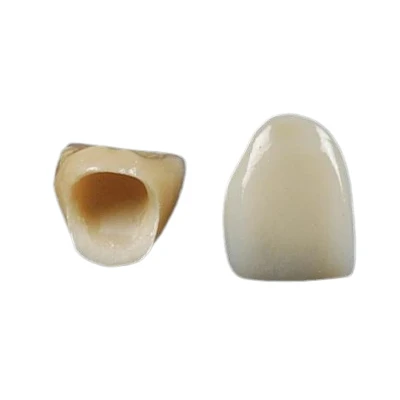
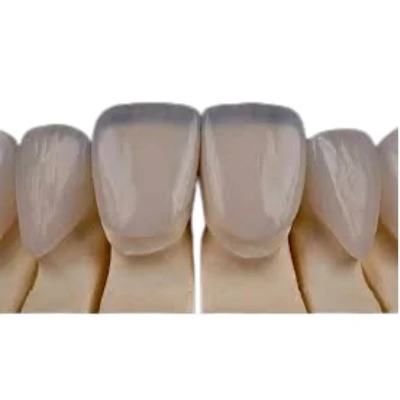
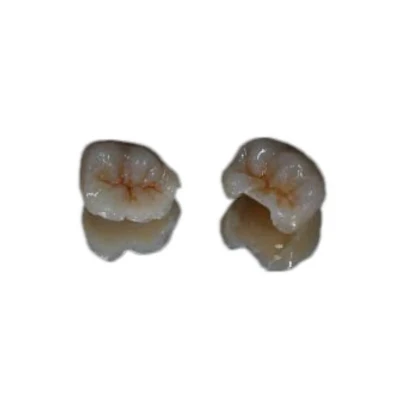

Implant crowns are commonly restored with either screw retention or cement retention. Both approaches can work predictably, but they create different clinical and prosthetic trade-offs. Screw-retained implant crowns offer easier retrieval and avoid intraoral cement, while cement-retained crowns remain useful when implant position, insertion path, or esthetic demands make screw access unfavorable.
For many cases, screw retention is preferred when the implant position allows it. The final choice, however, should follow the actual restorative conditions rather than a fixed rule.

Screw-Retained vs. Cement-Retained Implant Crowns: The Quick Answer
A screw-retained implant crown is secured to the implant or implant abutment with a prosthetic screw. A cement-retained implant crown is cemented onto an implant abutment in a way similar to a conventional crown.
The main differences are straightforward:
|
Clinical Factor |
Screw-Retained Implant Crown |
Cement-Retained Implant Crown |
|
Retrievability |
Easy to remove in most cases |
More difficult to retrieve |
|
Residual cement |
No intraoral crown cement |
Cement must be carefully controlled |
|
Screw access |
Required |
No screw-access opening through the crown |
|
Esthetics |
Depends on access position |
Helpful when screw access would compromise a visible surface |
|
Implant angulation |
Requires acceptable restorative trajectory |
Can offer more flexibility in some angulated cases |
|
Maintenance |
Easier to access and service |
Crown removal may be difficult |
|
Main biological concern |
No cement-related risk |
Residual cement around the implant |
|
Main technical concern |
Screw loosening, screw or component issues |
Decementation and difficult retrieval |
Clinical studies and systematic reviews comparing screw-retained and cement-retained implant prostheses do not support a simple universal winner. Instead, the two designs tend to present different biological and technical complication profiles.
When the screw-access channel emerges in a favorable location and the restoration can seat along a predictable insertion path, screw retention usually offers the stronger long-term maintenance advantage.
Cement retention becomes more useful when screw access would compromise esthetics, crown morphology, or the ability to seat the restoration properly.
How Screw-Retained and Cement-Retained Implant Crowns Work
A screw-retained implant crown uses a mechanical screw connection to secure the restoration to the implant. Depending on the restorative design, the crown may connect through a titanium base or form part of a crown-abutment assembly. A screw-access channel passes through the restoration so the prosthetic screw can be inserted and torqued. The access opening is then sealed with an appropriate restorative material.
A screw-retained zirconia implant crown, for example, combines this retrievable fixation concept with a zirconia restorative structure.
Its most important feature is retrievability. The crown can usually be removed later without destroying the restoration.
A cement-retained implant crown follows a different structure. An abutment is attached to the implant first, and the crown is cemented over that abutment. The abutment may be prefabricated or custom designed. The choice between custom and stock implant abutments can affect emergence profile, margin location, restorative contour, and cement accessibility.
Because no screw-access channel passes through the crown, cement-retained restorations can provide more flexibility where an access opening would interfere with the visible surface or occlusal anatomy.
The trade-off is that the crown may be much more difficult to remove once it has been definitively cemented.
Screw-Retained vs. Cement-Retained: Key Differences at a Glance
The choice between screw-retained and cement-retained implant crowns is not mainly about which design is more modern. It is about which design creates fewer compromises for the specific implant position and long-term maintenance plan.
|
Consideration |
Screw-Retained |
Cement-Retained |
|
Future retrieval |
Strong advantage |
Limited |
|
Cement-related biological risk |
Avoided |
Requires active control |
|
Access-hole management |
Necessary |
Not applicable |
|
Implant-position sensitivity |
Higher |
More forgiving in selected cases |
|
Esthetic-zone flexibility |
Good when access is favorable |
Useful when access would emerge facially |
|
Restorative space |
Often advantageous when space is limited |
Requires adequate abutment form and height |
|
Insertion path |
Must follow implant connection geometry |
Crown can follow the abutment preparation path |
|
Long-term servicing |
Easier |
May require crown removal or replacement |
|
Multi-unit maintenance |
Often advantageous |
Less convenient |
|
Laboratory design |
Screw trajectory and component compatibility are critical |
Abutment design and cement margin position are critical |
The most important factors are usually retrievability, cement control, screw-access position, implant angulation, and insertion path.
Those five considerations often determine the retention choice before minor differences in cost or fabrication technique become relevant.
Biological vs. Mechanical Complications: The Most Important Trade-Off
Neither retention method is free of complications. What changes is the type of complication that is more likely to require attention.
Biological Considerations: Residual Cement and Peri-Implant Tissues
Residual cement is one of the most important concerns with cement-retained implant crowns.
When crown margins are positioned deeply below the gingival margin, excess cement can be difficult to see and remove completely. Research examining residual cement and peri-implant inflammation has associated retained subgingival cement with inflammatory complications around implants.
These complications can include peri-implant mucositis and, in susceptible situations, peri-implantitis. The American Academy of Periodontology provides additional information on peri-implant mucositis and peri-implantitis and the distinction between these peri-implant conditions.
This does not mean that every cement-retained restoration will create peri-implant disease. Abutment design, margin position, cementation technique, oral hygiene, patient risk factors, and maintenance all influence the outcome.
Custom abutments can help reduce cement-related risk by positioning the restorative margin in a more accessible location. A well-designed cement-retained restoration should make cement cleanup predictable rather than treating it as an afterthought.
Screw-retained restorations avoid this specific issue because no intraoral crown cementation is required.
Mechanical and Technical Complications
Screw retention introduces a different set of concerns.
Reported complications include:
- Screw loosening
- Screw fracture
- Component fatigue
- Ceramic complications around the access channel
- Loss of access-channel seal
Published reports cited in the reference material place cumulative screw-loosening rates in roughly the 5–12% range in some clinical settings, while screw fracture has been reported at approximately 1–3% over longer follow-up periods. These numbers vary considerably with implant system, screw design, restoration type, functional loading, and study duration.
Occlusal design matters because non-axial loading and premature contacts can contribute to mechanical complications. Understanding the causes of high occlusion in dental crowns is therefore relevant when evaluating both implant-supported and tooth-supported restorations.
Cement-retained crowns avoid an occlusal screw-access channel, but they may experience decementation. Reported cumulative decementation rates have been in the 2–8% range in some studies.
The practical difference is important: screw-retained complications are often easier to access because the restoration can be removed. A problem under a cement-retained crown may require crown removal or even remanufacture.
The clinically useful question is therefore not which design has no complications. It is which complication profile can be prevented and managed more predictably in that specific case.

How Implant Angulation, Screw Access, and Insertion Path Affect the Choice
Implant position has a direct effect on the restorative design.
A screw-retained crown works best when the screw-access channel emerges through a location that does not compromise function or esthetics. In posterior restorations, this may be near the central occlusal area. In anterior restorations, a lingual or cingulum emergence is usually more favorable than a facial exit.
Screw-Access Position
If an implant is placed with an unfavorable restorative angle, the screw-access channel may emerge through the facial or labial surface of the crown. That can make a conventional screw-retained design difficult to accept in the esthetic zone.
The important issue is not simply whether the implant is angled. It is where the screw channel exits the final crown.
Cement retention can sometimes solve this problem because the crown does not need a screw opening through its external surface.
Angled Screw Channels
Angled screw-channel systems can redirect the screw-access trajectory and expand the number of cases that can be restored with screw retention.
Different systems permit different amounts of correction. Reference data commonly describe restorative correction in the approximate 10° to 20° or greater range, but the exact limit depends on the implant system, prosthetic screw, driver, and restorative component.
That is why confirming an implant crown's compatibility with the intended implant system is important before finalizing the restorative design.
Manufacturer-specific specifications should guide the final decision.
An angled screw channel can improve the access position, but it does not solve every angulation problem.
Insertion Path Is a Separate Issue
The insertion path is the direction along which the restoration must move to fully engage the implant connection and seat into its final position.
This is different from screw-access trajectory.
A restoration may have an acceptable angled screw channel and still be unable to seat because of interference from adjacent tooth contours. Internal implant connections may require the abutment or crown-abutment assembly to move several millimeters along the implant axis before complete seating occurs.
For this reason, implant planning should consider adjacent tooth contours, not only adjacent roots on a radiograph.
Minor contour adjustments may sometimes create clearance, but excessive adjustment can enlarge embrasures and increase the risk of food impaction. In those situations, a cement-retained crown on a carefully designed abutment may provide a more practical restorative path.
When Should You Choose Screw-Retained or Cement-Retained?
Retention should be selected after evaluating the restorative geometry, biological risk, and expected maintenance requirements.
When Screw-Retained Is Often Preferred
A screw-retained implant crown is often a strong choice when:
- The screw access emerges in an acceptable location
- Future retrieval is likely to be important
- Long-term maintenance is expected
- Residual cement is a concern
- Restorative or interocclusal space is limited
- The restoration forms part of a more complex implant prosthesis
- The crown can seat along the implant's insertion path without interference
Posterior implant crowns often meet these conditions because esthetic limitations are reduced and the occlusal surface may provide a suitable access location. Material and contour still matter, and a well-designed zirconia implant crown may be fabricated with different retention strategies depending on the actual implant position.
That does not mean every posterior implant should automatically be screw retained. Occlusion, implant position, restorative thickness, component compatibility, and access location still need to be evaluated.
When Cement-Retained May Be More Appropriate
Cement retention remains useful when:
- The screw channel would emerge through an unacceptable facial or labial surface
- An access opening would significantly compromise esthetics
- The implant's insertion path prevents predictable seating of a screw-retained crown
- Implant angulation cannot be adequately managed with an available angled screw-channel system
- A custom abutment can provide a favorable margin position and predictable cement cleanup
Anterior restorations are often more sensitive to access position because even a small facial opening can affect the appearance of the crown. However, an anterior implant with a favorable cingulum access may still be an excellent screw-retained case.
A practical clinical selection framework looks like this:
|
Clinical Situation |
Retention Often Considered |
|
Predictable future retrieval required |
Screw-retained |
|
Residual cement should be avoided |
Screw-retained |
|
Favorable occlusal or lingual access |
Screw-retained |
|
Limited restorative space |
Often screw-retained |
|
Multi-unit restoration requiring maintenance |
Often screw-retained |
|
Facial screw-access position |
Cement-retained or ASC evaluation |
|
Difficult implant insertion path |
Cement-retained may be useful |
|
Highly esthetic anterior case |
Case-dependent |
|
Angulated implant |
Evaluate ASC, insertion path, and cement option |
The crown should follow the implant position and restorative requirements. The implant should not be forced into a preferred retention philosophy after placement.
Custom Abutments, Angled Screw Channels, and Screwmentable Crowns
Modern implant prosthodontics offers more than a simple choice between a conventional screw-retained crown and a conventional cement-retained crown.
Custom Abutments
A custom implant abutment is individually designed for the implant position, soft-tissue contour, and planned restoration.
Titanium and zirconia custom abutments can help control:
- Emergence profile
- Crown margin location
- Restorative height
- Soft-tissue support
- Esthetic transition
- Cement accessibility
For cement-retained restorations, margin placement is particularly important. Keeping the margin accessible can make excess cement easier to identify and remove.
Angled Screw-Channel Solutions
Angled screw-channel systems can redirect an unfavorable access opening without changing the underlying implant position.
They are useful when the original access trajectory is close to acceptable but requires correction. Their use depends on implant-system compatibility and manufacturer limits.
Screwmentable Implant Crowns
A screwmentable implant crown combines extraoral cementation with final screw retention.
The crown is cemented to the abutment outside the mouth. Excess cement can then be removed and inspected before the complete crown-abutment assembly is screwed to the implant.
This approach can preserve retrievability while reducing the risk of residual intraoral cement. It may also provide restorative flexibility where a two-piece crown-and-abutment design is useful.
Screwmentable restorations are not a universal solution. Insertion path, component compatibility, cement interface design, and available restorative space still require careful evaluation.
What the Dental Lab Should Evaluate Before Fabrication
A predictable implant crown starts with complete case information.
Before designing either a screw-retained or cement-retained restoration, the dental laboratory should evaluate the implant system, implant platform, scan-body data, implant position, angulation, restorative space, soft-tissue profile, adjacent teeth, opposing dentition, and planned occlusion.
Accurate digital records are especially important in implant cases. Knowing what a dental lab needs from an intraoral scan helps reduce ambiguity around implant position, soft-tissue contours, opposing anatomy, and occlusion before design begins.
For screw-retained implant crowns, digital design should confirm:
- Screw-access trajectory
- Insertion path
- Component compatibility
- Restorative thickness
- Contact areas
- Occlusal position
- For cement-retained restorations, the design must also address:
- Custom abutment contour
- Emergence profile
- Margin position
- Abutment height
- Cement space
- Crown insertion path
A CAD/CAM dental workflow allows many of these relationships to be evaluated before milling or final fabrication. Digital design is particularly useful when checking screw-access location, custom abutment geometry, restorative clearance, and occlusal relationships.
The retention type should therefore be treated as part of the prosthetic design process, not as a box selected at the end of a laboratory prescription.

Screw-Retained vs. Cement-Retained Implant Crowns: Final Decision
For many implant crown cases, screw retention is the preferred option when implant position and restorative geometry are favorable. It provides predictable retrievability, simplifies future maintenance, and eliminates complications specifically associated with residual intraoral cement.
Cement-retained crowns still have an important role. They can be the more practical choice when implant angulation, insertion path, or esthetic requirements make a screw-retained design difficult to execute without compromise.
The best restoration is the one that manages the biological, mechanical, esthetic, and maintenance requirements of the case with the fewest avoidable risks.
ADS Dental Laboratory Ltd provides customized screw-retained and cement-retained implant crowns, custom abutments, implant bridges, and other digital implant restorations for overseas dentists and dental laboratories. For cases where retention design, implant angulation, component compatibility, or restorative space requires additional evaluation, contact our team to discuss the case before fabrication.
FAQ
Are Screw-Retained Implant Crowns Better?
They are often preferred when screw-access position and insertion path are favorable, especially when retrievability and long-term maintenance are priorities. They are not automatically better in every implant position.
Are Cement-Retained Implant Crowns More Esthetic?
They can offer an advantage when a screw-access opening would emerge through a visible surface. When screw access is positioned favorably, however, screw-retained crowns can also achieve excellent esthetic results.
Can an Angled Implant Still Use a Screw-Retained Crown?
Often, yes. Angled screw-channel systems can redirect the access trajectory in selected cases. The amount of correction depends on the implant system and restorative components, and the restoration's insertion path must still be evaluated separately.