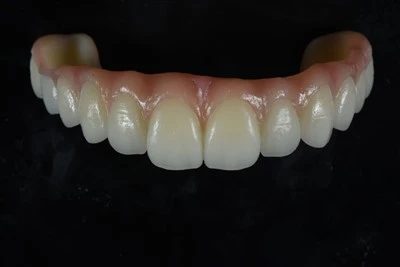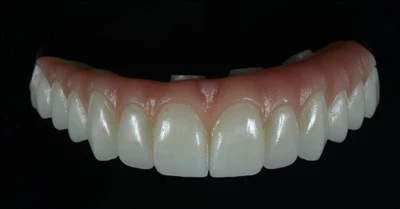
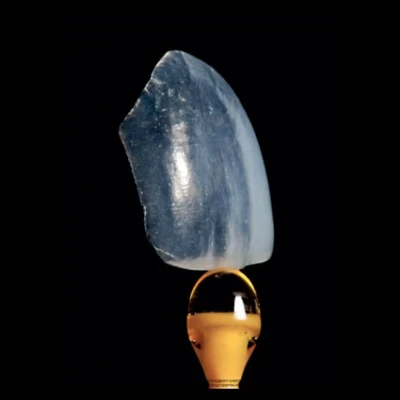
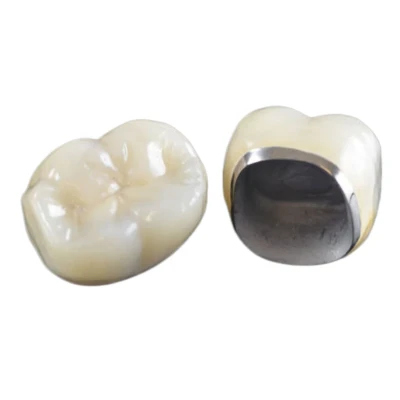
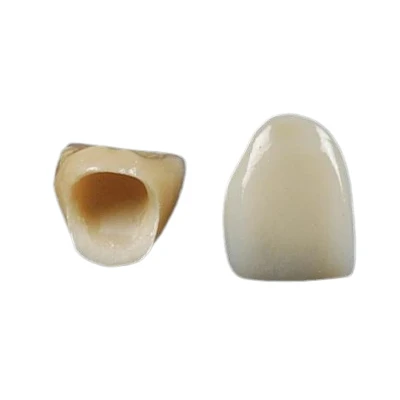
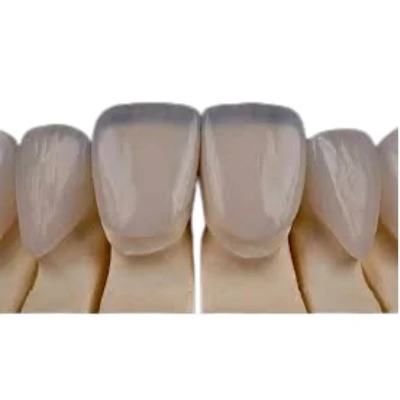
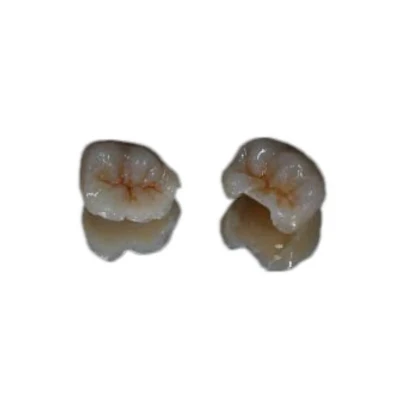
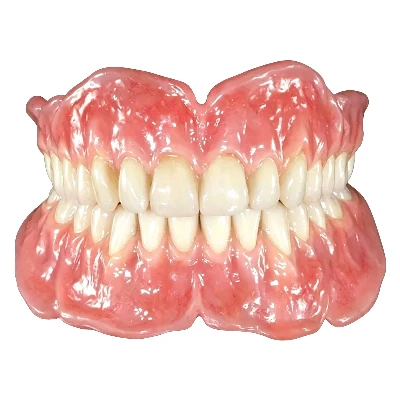

An implant crown is the visible part of a dental implant restoration. It restores the shape, function, contact points, and appearance of a missing tooth. Its success depends on more than the crown material alone. Implant position, abutment design, screw access, restorative space, occlusal load, and soft-tissue conditions all affect the final result.
The right approach is to select the connection and retention design first, then choose the material that fits the clinical demands of the case.

What Is an Implant Crown?
A dental implant restoration usually includes three main parts:
Implant fixture → abutment or Ti-base → implant crown
The implant fixture is placed in the jawbone. The abutment or Ti-base connects the implant to the visible restoration. The implant crown forms the tooth-shaped portion above the gumline.
Unlike a crown placed on a natural tooth, an implant crown does not rely on prepared enamel and dentin for support. It depends on the implant connection, prosthetic screw, abutment geometry, and restorative material.
Implants also lack the periodontal ligament found around natural teeth. This ligament provides a small degree of movement and sensory feedback under load. Because an implant is more rigidly anchored, excessive or poorly directed occlusal force can place more stress on the crown, screw, abutment, and surrounding bone.
For this reason, implant crown design must account for both appearance and force management.
Types of Implant Crowns by Retention Method
Implant crowns are commonly classified as screw-retained, cement-retained, or screwmentable. The retention method affects maintenance, esthetics, biological risk, and the laboratory workflow.
Screw-Retained Implant Crowns
A screw-retained implant crown is fixed to the implant or abutment with a prosthetic screw. The screw is accessed through a channel in the crown. After the screw is tightened, the access channel is usually sealed with PTFE tape and composite resin.
Its main advantage is retrievability.
A dentist can remove the restoration to inspect the implant connection, replace a screw, repair the crown, or manage soft-tissue concerns. Screw-retained restorations also avoid the risk of residual cement below the gingival margin.
They work best when the screw access channel exits in a suitable location. In posterior teeth, this is often near the central fossa. In anterior teeth, the preferred exit is usually on the palatal or lingual surface.
Problems arise when implant angulation directs the screw channel toward the facial surface or incisal edge. In those cases, an angulated screw channel, custom abutment, or cement-retained design may be more appropriate.
Cement-Retained Implant Crowns
A cement-retained implant crown is bonded to an abutment with dental cement. The crown has no screw access opening, which allows a more continuous occlusal or facial surface.
This design can be useful when implant angulation places the screw channel in an unacceptable location. It may also provide a more conventional crown form when the abutment has adequate height and retention.
The main concern is excess cement.
Cement left below the gingival margin can irritate peri-implant tissues and make maintenance more difficult. The risk increases when the crown margin is positioned deeply below the tissue. Retrieval is also less predictable because the crown may need to be sectioned or damaged during removal.
Cement retention is most suitable when the margin can be controlled, excess cement can be removed, and the abutment provides sufficient retention.
Screwmentable and Angulated Screw-Channel Designs
A screwmentable restoration combines extraoral cementation with screw retention. The crown is bonded to a Ti-base or abutment outside the mouth, then the assembled restoration is secured to the implant with a screw.
This approach reduces the risk of intraoral cement residue while preserving retrievability.
Angulated screw-channel systems allow the screw access opening to be redirected within the limits of the implant system. They are especially useful in selected anterior cases where a straight screw channel would emerge in a visible area.
|
Design |
Main advantage |
Main limitation |
Common use |
|
Screw-retained |
Easy removal and maintenance |
Access position depends on implant angle |
Posterior crowns and maintainable restorations |
|
Cement-retained |
No screw opening in the crown |
Cement residue and difficult retrieval |
Cases with unfavorable screw access |
|
Screwmentable |
Retrievable with extraoral bonding |
Requires compatible components and bonding space |
Ti-base and digital implant restorations |
|
Angulated screw channel |
Improves access position |
Limited by implant system and angle range |
Selected esthetic or misaligned cases |
The retention design should be selected before the crown material. A strong ceramic cannot correct an unsuitable screw channel or poorly positioned margin.
Common Implant Crown Materials
Implant crowns are made from several restorative materials. Each has a different balance of strength, translucency, wear behavior, and esthetic potential.
Monolithic Zirconia
is milled from a solid zirconium dioxide blank without a large external layer of veneering porcelain. It is widely used for posterior implant crowns because of its high fracture resistance and relatively low risk of veneer chipping.
Depending on the zirconia formulation and testing method, high-strength zirconia may show flexural strength values of approximately 900 to 1,200 MPa. These figures help explain its use in molar and high-load cases, but they do not make it indestructible.
Monolithic zirconia is often considered for:
- Posterior implant crowns
- Patients with high occlusal load
- Cases with limited restorative thickness
- Bruxism cases where layered porcelain would be more vulnerable
- Crowns requiring strong support around a screw access opening
Its limitations include lower translucency in some formulations and the possibility of an overly bright or opaque appearance if shade selection and characterization are not controlled.
The opposing dentition also matters. A poorly finished or rough zirconia surface can be abrasive. Proper polishing after occlusal adjustment is essential.
Layered Zirconia and Glass Ceramics
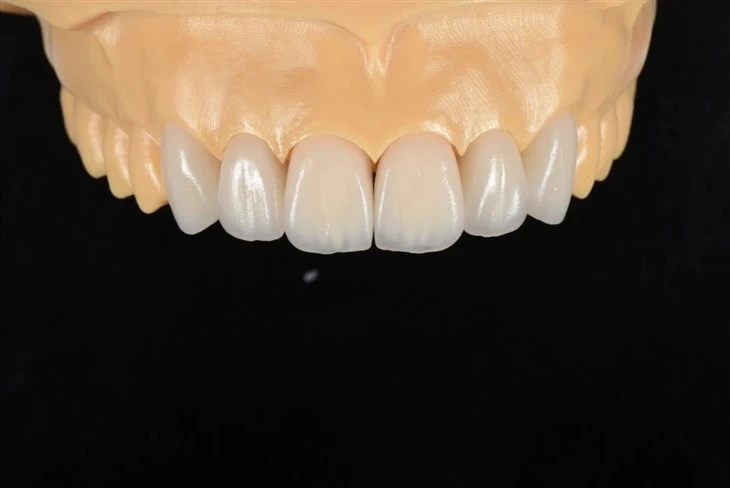
Layered zirconia uses a zirconia framework covered with veneering ceramic. The zirconia base provides strength and masking ability, while the outer ceramic improves translucency, shade depth, and incisal characterization.
It is often selected for anterior implant crowns where a monolithic restoration would not provide enough optical detail.
The trade-off is the veneering layer. Chipping can occur when porcelain is unsupported, too thick, or placed in a heavy contact area.
Lithium disilicate and other glass ceramics can also provide natural translucency and excellent shade integration. They may be used in selected anterior implant restorations, especially when there is adequate material thickness and the underlying abutment color is favorable.
However, glass ceramic should not be treated as the default material for every anterior implant crown. The decision depends on:
- Abutment color
- Ti-base or framework design
- Available restorative thickness
- Implant angulation
- Occlusal load
- Bonding surface
- Screw access location
Feldspathic porcelain and layering ceramics are most useful as esthetic surface materials rather than as unsupported, high-load implant crown structures.
Porcelain-Fused-to-Metal Crowns
A porcelain-fused-to-metal crown, or PFM crown, has a metal substructure covered with porcelain. The metal provides support and masking, while the porcelain creates a tooth-colored surface.
PFM implant crowns can still be used in both anterior and posterior areas. They are particularly useful when the laboratory needs a strong framework, reliable masking, or a material system with a long clinical history.
Their main limitations are esthetic. The metal framework reduces light transmission, and a gray appearance may become visible through thin tissue. Gingival recession can expose a dark cervical edge. The porcelain layer can also chip under high or poorly distributed load.
PFM remains a valid option, but it is no longer the automatic choice for every high-strength implant case.
Full Metal and Provisional Resin Crowns
Full metal crowns may be produced from gold, palladium, cobalt-chromium, titanium, or other approved alloys. They offer good durability and can function with relatively limited material thickness.
Their main disadvantage is obvious: the metallic appearance.
For that reason, full metal implant crowns are generally limited to posterior areas where esthetics are not a priority. They can serve as permanent restorations and should not be confused with provisional crowns.
Provisional implant crowns are more commonly made from PMMA, acrylic resin, bis-acryl, or other resin-based materials. They may remain in place for several weeks or several months, depending on healing, loading, and soft-tissue management.
A provisional crown can do much more than fill a temporary gap. It can help the restorative team:
- Shape the emergence profile
- Support the gingival margin and papillae
- Test crown length and contour
- Evaluate phonetics
- Check occlusal contacts
- Transfer a proven soft-tissue form to the final crown
For anterior implant treatment, the provisional stage can be one of the most important parts of the entire restorative process.
How Abutments and Ti-Bases Affect Crown Design
The crown material is only one part of the restoration. The abutment and Ti-base influence margin position, tissue support, retention, crown thickness, and color.
Stock vs. Custom Abutments
A stock abutment has a standardized shape and size. It can work well when implant position, tissue height, and crown form are straightforward.
A custom abutment is designed for the individual case. It allows the laboratory to control the emergence profile, margin location, abutment height, and support for the crown.
Custom abutments are especially useful when:
- The implant is angled
- The tissue height is uneven
- The crown requires a specific emergence profile
- The cement margin must be positioned for easier cleaning
- The abutment color must be managed in an esthetic area
A custom abutment can improve the restorative design, but it cannot fully correct a severely misplaced implant.
Titanium, Zirconia, and Ti-Base Components
Titanium abutments have well-established mechanical performance and are commonly used in posterior or high-load cases.
Zirconia abutments or zirconia mesostructures may be considered in selected esthetic cases, particularly when thin soft tissue could reveal a gray titanium color. Many modern designs combine a zirconia or ceramic restoration with a titanium base to preserve a metal implant connection.
A Ti-base is a prefabricated titanium component bonded to a CAD/CAM crown or mesostructure. Its height, bonding surface, anti-rotation features, and implant compatibility must be considered during design.
Custom abutments and Ti-bases are components of the implant restoration. They are not separate crown materials or retention categories.
When to Use Each Implant Crown Type
The best implant crown is the one that matches the position, load, tissue conditions, and maintenance needs of the case.
Anterior and Esthetic-Zone Cases
Anterior implant crowns require more than a white ceramic material. The final appearance depends on the crown, abutment, soft tissue, implant position, and provisional restoration.
Common options include layered zirconia, high-translucency zirconia, and selected glass ceramics. The material should be chosen only after evaluating:
- Tissue thickness
- Abutment color
- Smile line
- Adjacent tooth shade
- Implant depth and facial position
- Screw access location
- Available ceramic thickness
Thin tissue may allow a gray substructure to show through. A custom abutment, zirconia mesostructure, or carefully selected masking material may be needed.
The emergence profile should also be developed with care. In many anterior cases, a provisional crown is used to shape the tissue before the final crown is made.
Posterior and High-Load Cases
Posterior implant crowns are exposed to stronger chewing forces and usually have less demanding esthetic requirements.
Monolithic zirconia is often the first choice because it combines high strength with a lower risk of veneering porcelain chipping. PFM or full metal may still be appropriate in selected cases.
Material strength alone is not enough. The design must also consider:
- Bruxism
- Crown height
- Cantilever or off-axis loading
- Opposing tooth material
- Lateral contacts
- Screw access position
- Minimum material thickness
A strong crown placed in an uncontrolled occlusal scheme can still fail.
Limited Space or Unfavorable Implant Angulation
Limited interarch space affects almost every part of the restoration. It can reduce crown thickness, shorten the abutment, restrict Ti-base selection, and weaken the area around the screw channel.
Monolithic zirconia may be useful where space is limited, but only if the system's minimum thickness and bonding requirements can be met.
Unfavorable implant angulation may require:
- An angulated screw channel
- A custom abutment
- A cement-retained crown
- A different Ti-base
- A revised crown contour
The goal is not to force a preferred material into the case. The design should follow the available space and connection geometry.
Cases Requiring Soft-Tissue Shaping
When the peri-implant tissue has not reached the desired form, a customized provisional crown may be used to shape it gradually.
This is especially important in the anterior region. The provisional can support the gingival margin, guide the papillae, and create a more natural transition from implant platform to crown.
Once the tissue contour is stable, the provisional shape can be scanned or transferred to the final restoration.
|
Clinical situation |
Commonly considered option |
|
Posterior high-load case |
Monolithic zirconia |
|
High-esthetic anterior case |
Layered zirconia or selected glass ceramic |
|
Need for easy retrieval |
Screw-retained crown |
|
Unfavorable screw access |
Angulated channel or cement-retained crown |
|
Thin soft tissue |
Careful abutment and substructure color management |
|
Soft-tissue shaping |
Customized provisional crown |
|
Limited restorative space |
Monolithic zirconia with validated component dimensions |
|
High chipping risk |
Monolithic rather than heavily layered ceramic |
No single material is best for every implant site. Case selection should guide the restoration, not the other way around.
Key Factors Dentists and Labs Should Evaluate
Before designing the crown, the restorative team should review the complete case rather than only selecting a material from a prescription form.
Important information includes:
- Implant brand, platform, and connection
- Implant position and angulation
- Scan body type
- Screw access direction
- Available restorative space
- Anterior or posterior location
- Occlusal load and bruxism
- Opposing dentition
- Soft-tissue thickness
- Emergence profile
- Abutment or Ti-base color
- Need for retrievability
- Minimum material thickness
- Esthetic expectations
- Documented material sensitivities
A documented metal sensitivity should be evaluated across the whole restoration. A ceramic crown may still be bonded to a titanium base or connected to a titanium implant.
The strongest crown material cannot compensate for poor implant positioning, insufficient space, incompatible components, or excessive occlusal load.
Digital Workflow and Laboratory Communication
Digital implant crown production depends on accurate data from the clinic and correct component matching in the laboratory.
A typical workflow includes:
- Capturing the implant position with a compatible scan body
- Scanning the opposing arch and bite
- Confirming the implant system, platform, and connection
- Matching the correct implant library
- Designing the abutment, Ti-base restoration, and crown contour
- Milling or fabricating the restoration
- Completing staining, glazing, layering, or polishing
- Checking contacts, occlusion, screw access, and interface fit
The laboratory should also receive clear information about the retention preference, shade, tissue contour, provisional crown, bruxism, and esthetic expectations.
Missing implant details can cause more problems than the choice between two ceramic brands. An incorrect platform, scan body, library, or Ti-base can affect the entire restoration.
Consistent clinical-laboratory communication reduces remakes, chairside adjustment, and component mismatch.
Common Implant Crown Complications and How to Reduce Them
Implant crown complications are not caused by material alone. They usually involve a combination of design, component selection, occlusion, cementation, and maintenance.
Common problems include:
- Screw loosening
- Crown or Ti-base debonding
- Veneering ceramic chipping
- Crown fracture
- Loss of cement retention
- Residual cement
- Heavy or open contacts
- Poor emergence profile
- Shade mismatch
- Difficulty retrieving the restoration
Risk can be reduced by selecting a suitable retention method, maintaining adequate material thickness, following the implant system's torque and bonding instructions, and controlling occlusion.
Cement-retained crowns should have margins that allow reliable cement removal. Screw-retained crowns should preserve sufficient ceramic around the access channel.
For patients with bruxism, a high-strength material may be appropriate, but occlusal adjustment and a protective night guard may still be needed.

Choosing the Right Implant Crown for the Case
Implant crowns can be classified by retention method, material, abutment design, and clinical application. The correct choice starts with implant position, connection, screw access, and restorative space. Material selection comes next, based on load, esthetics, tissue conditions, and future maintenance.
ADS Dental Laboratory Ltd is a China-based Outsource Dental Lab providing custom implant crown, Ti-base, and abutment outsourcing services for overseas dentists and dental laboratories. Send us your implant system details, scan files, and case requirements to discuss the most suitable restorative design.
FAQ
What Is the Best Material for an Implant Crown?
There is no universal best material. Monolithic zirconia is commonly used for posterior and high-load cases. Layered zirconia or selected glass ceramics may be more suitable when anterior esthetics are the priority.
The final choice depends on space, implant position, abutment color, tissue thickness, and occlusion.
Is Screw-Retained Better Than Cement-Retained?
Screw-retained crowns are usually easier to remove and maintain, and they avoid residual cement. They are often preferred when the access channel exits in a suitable position.
Cement-retained crowns remain useful when the screw channel would compromise crown form or esthetics. Their margins must be designed for predictable cement removal.
Can an Implant Crown Be Removed or Replaced?
Yes. Many implant crowns can be repaired or replaced without removing the implant.
Screw-retained crowns are usually easier to retrieve. Cement-retained crowns may be more difficult to remove and can require sectioning.
How Long Does an Implant Crown Last?
The service life of an implant crown depends on material, occlusal load, bruxism, screw stability, tissue health, hygiene, and maintenance.
A well-designed crown can function for many years, but no material eliminates the need for regular examination and professional maintenance.