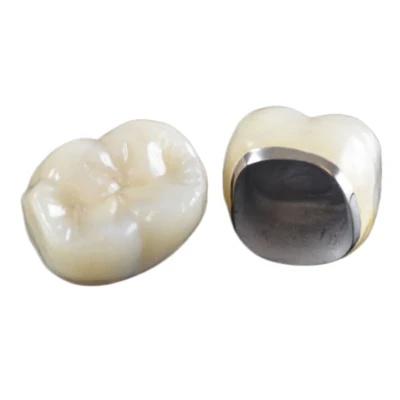
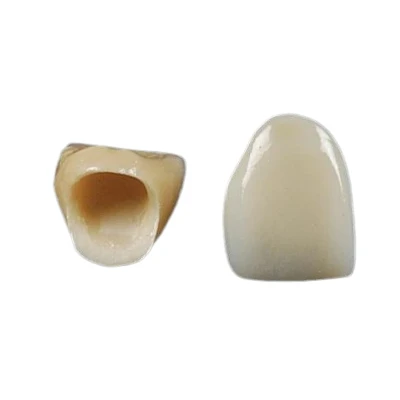
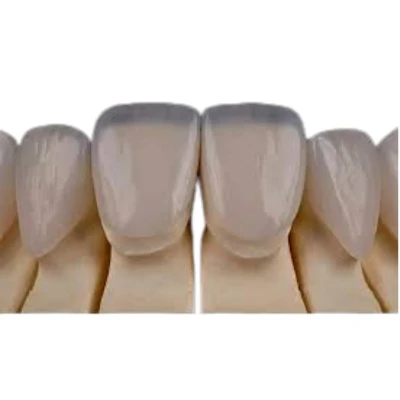

When a dental practice orders ceramic veneers from an outsourcing laboratory, one of the earliest production decisions is whether a lithium disilicate veneer should be heat-pressed or CAD/CAM-milled. Pressed ceramic veneers and milled ceramic veneers can both deliver excellent esthetics and longevity, yet their manufacturing workflows differ in nearly every respect - from the raw material state and equipment chain to the technician skill set and the clinical timeline the dentist ultimately experiences. Understanding those differences helps practices make informed prescribing decisions and helps laboratories set realistic expectations for marginal fit, esthetics, repeatability, and turnaround.
This guide compares pressed vs milled ceramic veneers from a dental laboratory manufacturing perspective: how each method works, where the workflows diverge, and what those differences mean for the finished restoration.
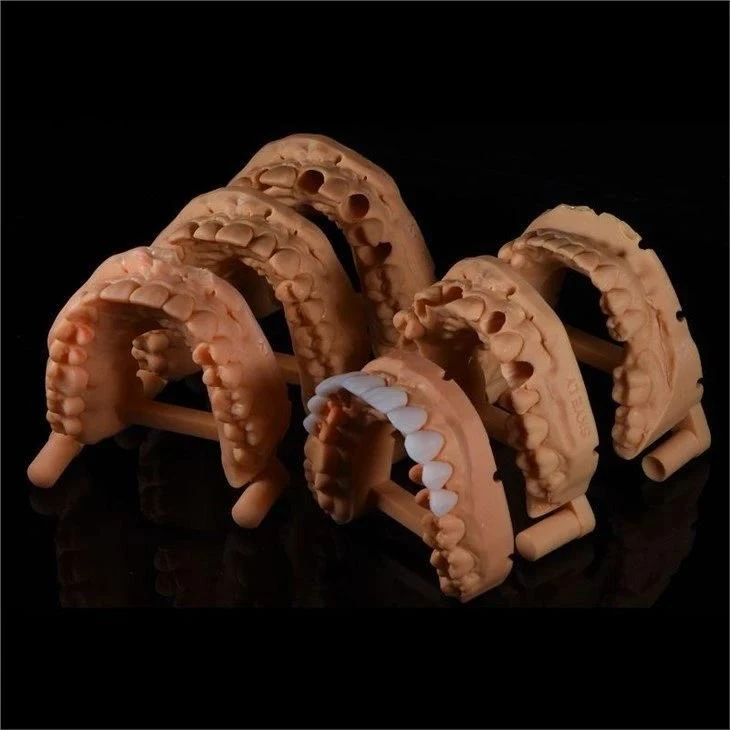
Lithium Disilicate: What Pressed and Milled Veneers Have in Common
Before examining how the two methods differ, it helps to note what they share. Both pressed and milled ceramic veneers are commonly made from lithium disilicate glass-ceramic, including widely used IPS e.max material systems. This material combines a glassy matrix with interlocking lithium disilicate crystals, giving it both the translucency needed for lifelike anterior esthetics and a flexural strength in the range of roughly 360 to 500 MPa - substantially stronger than conventional feldspathic porcelain.
The key distinction is not the material itself but the state in which that material arrives at the laboratory and the process used to shape it into a finished veneer. Pressed veneers begin as ingots that are heated and pressed into a mold. Milled veneers begin as partially crystallized blocks that are cut by a computer-controlled machine and then thermally crystallized. Same chemistry, different journey.
How Pressed Ceramic Veneers Are Made
The heat-pressing technique - sometimes called the lost-wax method - has been a mainstay of dental ceramics since the introduction of pressable glass-ceramics in the late 1990s. The workflow is fundamentally analog and artisanal, relying on the technician's hands and eyes at every stage.
The process unfolds in several distinct stages:
1. Wax-Up and Spruing
The technician builds a full-contour wax pattern on a die or digital print of the prepared tooth. This wax-up is where the veneer's anatomy, incisal characterizations, and cervical adaptation are sculpted by hand. Once complete, the pattern is sprued and attached to a base.
2. Investment and Burnout
The sprued wax-up is placed in a casting ring and surrounded by a phosphate-bonded investment material. After the investment sets, the ring goes into a burnout furnace that ramps to roughly 850–900°C, vaporizing the wax completely and leaving a precise negative cavity - the mold into which the ceramic will be pressed.
3. Pressing
A lithium disilicate ingot used for E.max press monolithic veneers (for example, IPS e.max Press) is placed in the sprue channel of a specialized press furnace. The furnace heats the ingot to approximately 920°C, at which point the ceramic becomes a viscous paste. A plunger then forces the molten ceramic into the investment mold under pressure, filling every detail of the wax-built form.
4. Divesting and Finishing
After cooling, the investment is broken away (divested) and the pressed veneer is recovered. The restoration is already fully crystallized, so no further firing is needed to develop strength. The technician then removes the sprue, refines margins, adjusts contour, and applies surface characterization - external stains and glazes fired in a ceramic furnace - to achieve the desired shade and individualization.
The defining strength of the pressed method is the wax-up stage. Because the technician sculpts the full anatomy in wax before the ceramic is even introduced, there is room for nuanced, tooth-specific characterization - mamelons, incisal halo, cervical translucency - that is difficult to replicate in a purely digital workflow.
How Milled Ceramic Veneers Are Made with CAD/CAM
The milled veneer pathway follows a CAD/CAM dental workflow and is a fully digital, subtractive manufacturing process. Rather than building a pattern by hand and pressing ceramic into a mold, the laboratory works from a digital scan and uses a milling machine to cut the restoration from a pre-fabricated ceramic block.
The stages are as follows:
1. Digital Scan and CAD Design
The process begins with an intraoral or model scan, producing a digital file of the prepared tooth and adjacent dentition. In CAD software, the technician or designer selects the appropriate block shade and translucency, then designs the veneer's contour, margin, and emergence profile on screen. The design is exported as a manufacturing file.
2. Block Selection and Milling
The CAD file is sent to a CAM milling machine. A partially crystallized lithium disilicate block - the type used for digital E.max veneers, for example IPS e.max CAD - is loaded into the machine. At this stage the block has a characteristic blue tint and is in a "soft" or meta-state, making it easier to mill without chipping. Diamond burs cut the block to the designed geometry, producing the veneer in its pre-crystallized form.
3. Crystallization Firing
After milling, the veneer is placed in a ceramic furnace for a crystallization firing at approximately 840–850°C. During this cycle the material transforms from its partially crystallized state to full lithium disilicate crystal density, developing its final strength (around 360–500 MPa) and shedding the blue tint in favor of the final tooth-colored shade. Stains and glaze can be applied and fired in the same or a subsequent cycle.
4. Finishing and Characterization
The crystallized veneer is removed, margins are verified and refined, and any final surface characterization - stains, glaze, polish - is applied. Because the anatomy was defined digitally rather than hand-sculpted, the degree of individualization depends on the CAD design's sophistication and the technician's finishing work.
In a production dental lab, this is why milled ceramic veneer manufacturing is better understood as a workflow, not a single milling step. At ADS, documented digital capabilities include digital case receiving, STL and intraoral scan processing, CAD/CAM design, digital scanning, milling, and case tracking; technician-led steps such as ceramic layering, staining, glazing, surface texture, contouring, and margin finishing remain part of the final result.
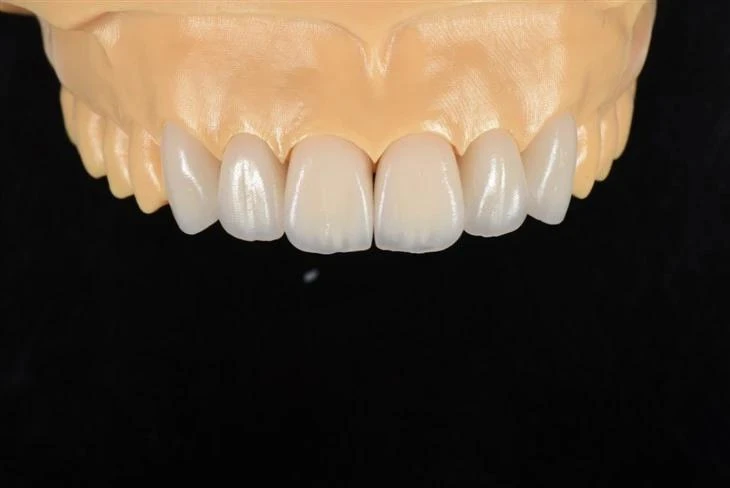
Pressed vs Milled Veneers: Key Manufacturing Differences
With both workflows now laid out, the differences become clear. The table below summarizes the key manufacturing distinctions:
|
Dimension |
Pressed Veneers |
Milled Veneers |
|
Starting Material |
Solid lithium disilicate ingots (pre-crystallized) |
Partially crystallized blocks in a "soft" blue state |
|
Shaping Method |
Lost-wax heat-pressing into an investment mold (~920°C) |
Subtractive CNC milling from a block, then crystallization firing (~840°C) |
|
Design Input |
Hand-sculpted wax pattern on a die |
Digital CAD design from an intraoral or model scan |
|
Crystallization |
Already fully crystallized when pressed; no firing needed for strength |
Requires a separate crystallization firing to reach final strength |
|
Equipment Chain |
Waxing instruments, investment ring, burnout furnace, press furnace |
Intraoral/lab scanner, CAD software, CAM milling machine, crystallization furnace |
|
Technician Skill Profile |
Strong wax-sculpting and analog ceramics artistry |
Digital design proficiency and CAD/CAM workflow management |
|
Esthetic Individualization |
High - anatomy and internal effects built into the wax pattern |
Moderate to high - depends on CAD design depth and external staining |
|
Turnaround Speed |
Slower - multiple thermal cycles and hands-on stages |
Faster - digital design and automated milling streamline production |
|
Reproducibility |
Lower - each wax-up is a one-off, hand-crafted restoration |
Higher - digital files can be stored, recalled, and re-milled |
Marginal Fit: Pressed vs Milled Veneers
Marginal fit is one of the most clinically consequential differences, and it is also one of the most nuanced. Both methods can produce veneers with clinically acceptable adaptation, but the sources of precision differ.
In the pressed workflow, marginal accuracy depends heavily on the investment material's expansion characteristics and the technician's skill in waxing a precise margin. A well-executed wax-up and properly compensated investment yield excellent adaptation - the pressed ceramic flows into the mold under pressure, capturing fine detail. However, the process introduces multiple variables (investment setting expansion, thermal expansion of the ring, burnout schedule) that can affect the final fit.
In the milled workflow, marginal accuracy is governed by the precision of the digital scan, the accuracy of the CAM milling machine's axes, and the compensation for the material's shrinkage during crystallization. Modern five-axis dental milling machines can cut to tolerances of tens of microns, and the crystallization shrinkage of lithium disilicate blocks is well-characterized and compensated for in the CAD software. When the scan is clean and the machine is well-maintained, milled veneers can achieve very consistent marginal adaptation.
For long-term dental lab outsourcing, repeatability therefore depends on more than the shaping method. ADS treats it as a system issue: production-stage case scanning, technician traceability, magnification-assisted inspection, margin and contact checks, occlusal inspection, shade and esthetic inspection, and final QC surround the manufacturing step rather than relying on milling alone.
Neither method is inherently superior in marginal fit. The deciding factor is process control - a laboratory that masters its investment technique can press veneers with excellent margins, just as a lab with a well-calibrated mill and clean digital input can mill them to the same standard.
Esthetic Differences Between Pressed and Milled Veneers
This is where the two methods diverge most visibly in the eyes of discerning clinicians. The pressed technique's wax-up stage allows the technician to build internal esthetic effects directly into the restoration - subtle dentin lobes, incisal edge translucency, developmental grooves, and surface texture are all sculpted in wax before pressing. When the ceramic flows into that mold, it captures those characterizations in the body of the veneer, not just on the surface. The result is a restoration with depth and natural vitality.
The milled technique, by contrast, produces a restoration whose internal structure is uniform - the block is a single, homogeneous shade and translucency. Esthetic individualization is achieved through external staining and glazing applied after crystallization. While modern ceramic stains and glazes are highly effective, surface characterization can lack the three-dimensional depth that internal layering provides, particularly for highly visible anterior cases with complex shade requirements (such as tetracycline discoloration or significant color transitions).
That said, multi-shade and gradient blocks (such as IPS e.max CAD Multi) have narrowed this gap by building color transitions into the block itself, and skilled digital designers can create sophisticated surface anatomy in CAD. The esthetic difference is real but is no longer as stark as it once was.
This is also why a digital workflow should not be equated with a fully automated esthetic result. ADS combines a dedicated Veneer Aesthetic Center with technician-led finishing and has close to 200 professionals involved in veneer-related work. In practice, translucency, surface texture, shade transition, incisal characterization, natural morphology, and minimal thickness still depend heavily on experienced esthetic judgment after the core geometry has been created.
Turnaround, Consistency, and Dental Lab Outsourcing
For dental practices and laboratories that outsource veneer cases, the manufacturing method has direct implications for turnaround time, consistency, cost, and remake management. In a long-term outsourcing relationship, pressed vs milled veneers is also a production-management question: how easily designs can be repeated, how much output depends on individual technician steps, and how consistently multi-unit cases can be reproduced over time.
A. Turnaround
Milled veneers generally offer faster production cycles. Once the digital design is complete, the milling machine runs with minimal technician intervention, and crystallization is a single furnace cycle. Pressed veneers require hands-on waxing, investment, burnout, and pressing - each a discrete thermal and manual step that adds time.
B. Consistency Across Cases
For multi-unit cases or repeat orders, the digital pathway excels. A stored CAD file can be re-milled with high fidelity, making it straightforward to produce matching or replacement veneers. Pressed veneers, being individually hand-waxed, are harder to replicate exactly if a remake is needed months or years later.
C. Single-Visit Potential
Chairside CAD/CAM systems can allow milled veneers to be designed, milled, and crystallized in a single appointment when the practice has the necessary equipment in-house. Pressed veneers, requiring a lab-based thermal process, cannot be produced chairside and always involve a laboratory turnaround.
D. Complex Case Handling
Highly individualized anterior cases - where shade matching demands internal layering, custom mamelon patterns, or complex masking of discolored substrates - often benefit from the pressed technique's hand-sculpted approach. Straightforward single-unit or multi-unit cases with predictable shade requirements are well-served by milling.
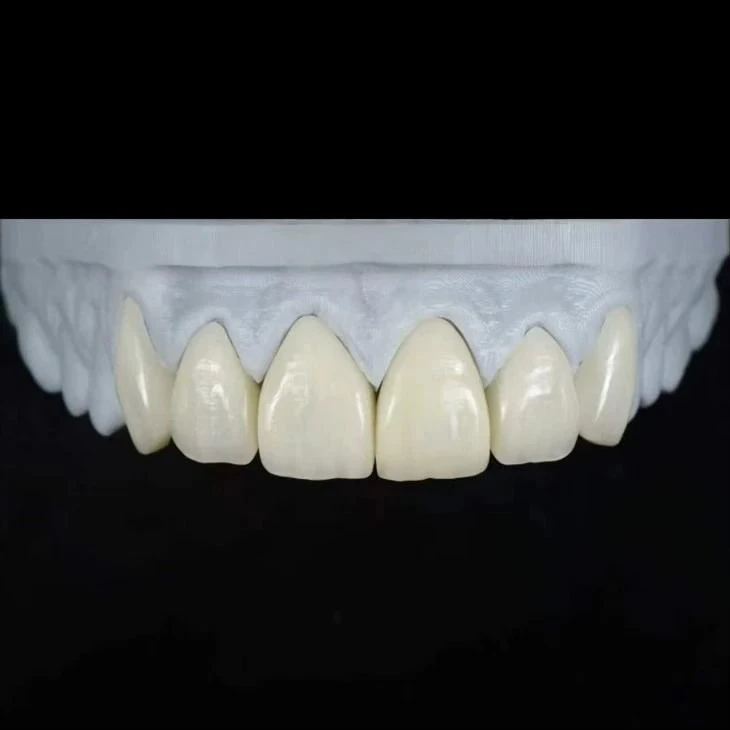
Material Properties of Pressed and Milled Lithium Disilicate
Once fully processed, both pressed and milled lithium disilicate veneers arrive at similar mechanical endpoints. Pressed IPS e.max Press reports a flexural strength of approximately 400 MPa. Milled IPS e.max CAD, after crystallization, reaches approximately 360–500 MPa depending on the specific block variant and firing protocol. Both materials are etchable with hydrofluoric acid, enabling strong resin-bonded adhesion to enamel - a critical factor in veneer retention and longevity.
~400 MPa
Flexural strength of pressed lithium disilicate (IPS e.max Press)
Clinical studies tracking lithium disilicate veneers over periods of 10 years and beyond have reported survival rates above 90% for both manufacturing routes, with failures most commonly related to fracture or debonding rather than material degradation. The choice between pressed and milled does not, in itself, meaningfully alter the long-term clinical prognosis when each is executed to standard.
How to Choose Between Pressed and Milled Ceramic Veneers
Neither pressed nor milled ceramic veneers are universally "better." The optimal choice depends on the specific clinical situation, the laboratory's capabilities, the priorities of the prescribing dentist, and sound veneer preparation guidelines:
|
Clinical Scenario |
Preferred Method |
Rationale |
|
High-esthetic anterior, complex shade (e.g., tetracycline staining) |
Pressed |
Internal layering and custom characterization built into the wax-up |
|
Straightforward single or multiple veneers, standard shade |
Milled |
Faster turnaround, high reproducibility, lower per-unit cost at volume |
|
Same-day / chairside delivery |
Milled |
In-office CAD/CAM systems can design, mill, and crystallize in one visit |
|
Remake or replacement of an existing veneer |
Milled |
Stored digital file enables precise reproduction of the original design |
|
Highly individualized surface texture and mamelon detail |
Pressed |
Hand-sculpted wax captures fine anatomical nuance the mill may not |
How ADS Approaches Ceramic Veneer Manufacturing
At ADS, a full-service digital dental laboratory, our documented ceramic veneer capability is built around digital case receiving, STL and intraoral scan processing, CAD/CAM design, milling, digital scanning, and technician-led esthetic finishing. Rather than treating digital manufacturing as a substitute for craftsmanship, our production philosophy is "Digital Precision + Experienced Dental Craftsmanship": digital tools support design and manufacturing accuracy, while technicians remain responsible for the esthetic and finishing details that make a veneer look natural.
ADS supports a broad range of dental veneers, including IPS e.max veneers, ultra-thin veneers, no-prep and minimal-prep veneers, hand-layered veneers, and other customized aesthetic veneer cases. A dedicated Veneer Aesthetic Center and a veneer-related team of close to 200 professionals focus on translucency, surface texture, shade transition, incisal characterization, natural morphology, minimal thickness, and individualized esthetics.
The same principle applies to quality control. ADS uses production-stage scanning, technician traceability, magnification-assisted inspection, margin and contact inspection, occlusal inspection, shade and esthetic inspection, and final QC. For long-term customers, relatively stable technicians or production teams can also be arranged according to production needs to improve style and quality consistency across recurring cases.
For a dentist or dental laboratory, the practical question is therefore broader than whether a veneer is "pressed" or "milled." The more useful evaluation is whether the laboratory can match the case prescription, material, stump shade, target shade, preparation design, required translucency, manufacturing workflow, technician finishing, and QC into one controlled process.
Conclusion
Pressed and milled ceramic veneers can both produce successful lithium disilicate restorations, but they reach the result through different manufacturing pathways. Pressing relies on a lost-wax mold and multiple manual and thermal stages; milling relies on scanning, CAD/CAM design, subtractive machining, and crystallization. The better choice is case-specific and should consider preparation and available thickness, stump shade and target shade, esthetic complexity, repeatability needs, turnaround, technician finishing, and the laboratory's process control rather than assuming one method is universally superior.
For ADS Dental Laboratory Ltd, ceramic veneer production centers on a full digital workflow combined with experienced dental craftsmanship, supported by a dedicated aesthetic veneer team and structured QC. If you have a veneer outsourcing case to discuss, contact our team to review your digital files, material and shade requirements, preparation details, and production plan.
FAQ
1. Are pressed ceramic veneers stronger than milled ceramic veneers?
When both are made from properly processed lithium disilicate, pressed and milled veneers can reach similar mechanical performance ranges. Strength alone is usually not a sufficient reason to choose one manufacturing route; preparation design, material selection, bonding, thickness, finishing, and process control all matter.
2. Which method provides better marginal fit?
Neither method is automatically superior. Pressed veneer fit depends on wax-up accuracy, investment behavior, burnout, and pressing control, while milled veneer fit depends on scan quality, CAD settings, milling calibration, bur condition, and crystallization compensation. A controlled laboratory workflow and final margin inspection are more important than the label "pressed" or "milled."
3. Are pressed veneers always more esthetic than CAD/CAM veneers?
No. Pressed workflows can provide extensive hands-on control for highly individualized anterior cases, while modern CAD/CAM veneers can also achieve high-level esthetics when digital design is combined with skilled staining, glazing, surface texture, contouring, and, where indicated, ceramic layering. The case requirements and technician finishing strategy are decisive.
4. Are milled veneers better for multi-unit cases or remakes?
Digital design files can improve repeatability because the geometry can be stored and reproduced, which is useful for multi-unit cases and future remakes. However, reproducing the original shade, translucency, surface texture, and characterization still requires consistent materials, technician finishing, and QC.
5. Can both pressed and milled veneers be made from lithium disilicate?
Yes. Lithium disilicate is available in manufacturing formats designed for pressing as well as CAD/CAM milling. The ceramic chemistry may be similar, while the starting state, shaping process, thermal steps, and production workflow differ.