

3D printing has moved from an experimental novelty to a production mainstay in dental laboratories worldwide. Adoption among dental labs climbed from roughly 10% in 2014 to over 57% by 2022, with larger facilities reporting penetration above 90%.
The technology now touches nearly every product category a modern dental laboratory produces-from diagnostic models to permanent restorations. But the question is no longer simply whether a lab should adopt 3D printing. The more important questions are where 3D printing fits into the dental laboratory workflow, what it can replace, and where other manufacturing methods still make more sense.
In a modern digital dental lab workflow, 3D printing works alongside intraoral scanning, CAD design, CNC milling, post-processing, technician finishing, and quality control. Understanding how these processes connect is essential for laboratories that want to improve efficiency without treating additive manufacturing as an isolated technology.

What 3D Printing Means in a Dental Laboratory
3D printing-also called additive manufacturing-builds physical objects layer by layer from a digital file. This differs from subtractive manufacturing such as CNC milling, which cuts material away from a solid block.
For medical-device manufacturing, the U.S. FDA has also published technical guidance covering additive manufacturing medical devices, including considerations related to design, manufacturing processes, and device testing.
In dentistry, the dominant resin-based printing technologies include stereolithography (SLA), digital light processing (DLP), and masked stereolithography (mSLA/LCD). These systems cure liquid photopolymer resin using a light source.
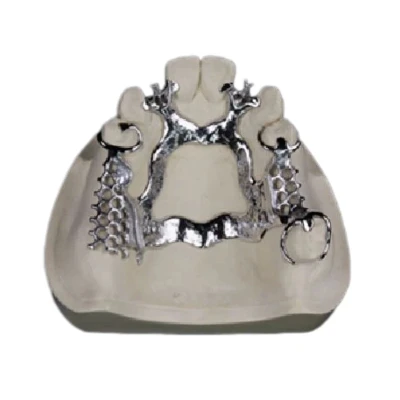
A second category is powder-bed fusion, including selective laser melting (SLM), which fuses metal powder layer by layer and can be used for cobalt-chrome and titanium frameworks.
These technologies are not interchangeable.
Resin-based dental 3D printing systems are commonly used for:
- Diagnostic and working models
- Surgical guides
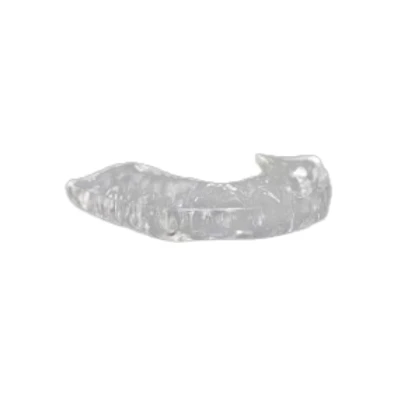
- Splints and guards
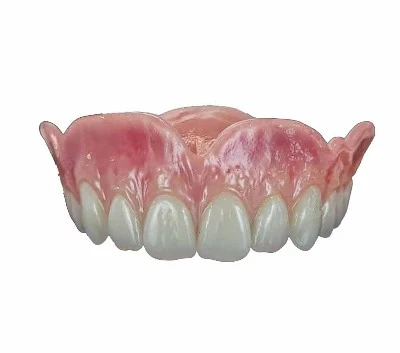
- Denture bases
- Temporary restorations
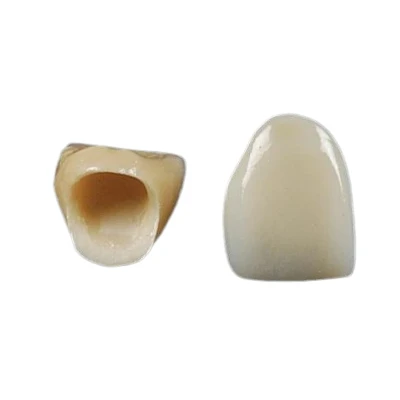
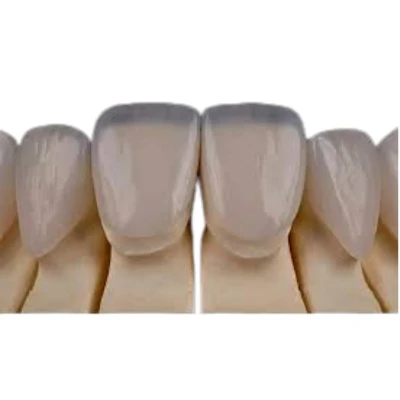
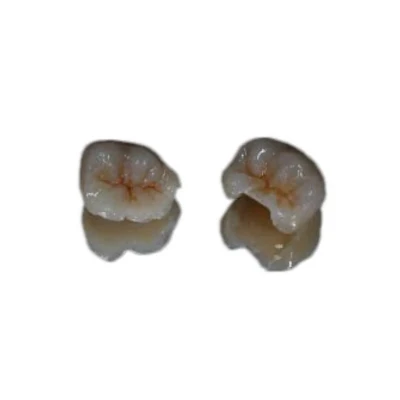
- Certain permanent restorative applications
Metal additive manufacturing may be used for:
- Crown and bridge frameworks
- Partial denture frameworks
- Metal clasps
- Certain implant-related components
Understanding which printing technology matches a particular product is one of the first steps toward integrating 3D printing in a dental laboratory rather than adding a printer as a disconnected production tool.
Where 3D Printing Fits in the Digital Dental Laboratory Workflow
A modern dental laboratory workflow is no longer simply a linear sequence of manual fabrication steps. Increasingly, it operates as a connected digital pipeline, with 3D printing serving as one manufacturing method within that system.
A simplified digital dental workflow may look like this:
|
Workflow Stage |
Input |
Output |
Role of 3D Printing |
|
Data capture |
Intraoral scan or model scan |
STL/PLY file |
None-provides the digital input |
|
CAD design |
STL file |
Designed restoration or appliance |
None-design is software-based |
|
Manufacturing |
CAD file |
Physical part |
Primary production method for suitable indications |
|
Post-processing |
Printed green part |
Finished device |
Washing, curing, finishing |
|
Quality control |
Finished device |
Pass/fail |
Dimensional and production verification |
The workflow often begins with an intraoral scanner or laboratory model scan. For predictable downstream production, the quality and completeness of the intraoral scan submitted to the dental laboratory are important because errors at the capture stage can carry through CAD design and manufacturing.
Digital cases are commonly transferred as STL or related file formats. Understanding STL files for dental labs, including file quality and submission requirements, therefore forms another important part of a reliable digital production chain.
Printing enters directly at the manufacturing stage, but its influence extends both backward and forward through the workflow.
When a component will be printed rather than milled, cast, or pressed, the CAD designer may need to account for support placement, margin design, wall thickness, and build orientation.
The production steps after printing also change according to the material and indication. A printed surgical guide, for example, requires washing and light curing, while a metal framework may require stress relief, support removal, and sandblasting.
The important point is that 3D printing does not replace CAD/CAM. It is a manufacturing method within a broader CAD/CAM dental workflow.
Dental laboratories that treat the printer as a standalone machine may gain some production capacity, but laboratories that integrate printing into file handling, CAD design, manufacturing, post-processing, and quality control can capture much more of the potential workflow benefit.
What Dental Laboratories Use 3D Printing For
Diagnostic and Working Models
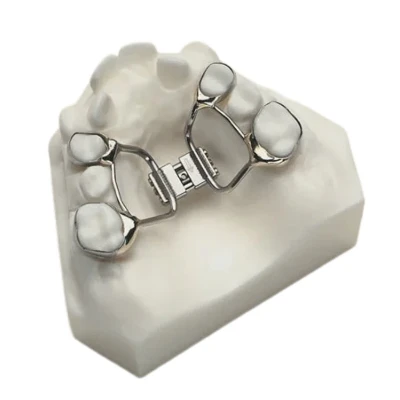
Printed models remain one of the highest-volume applications of dental laboratory 3D printing.
Resin models can replace conventional stone models while providing good dimensional stability, eliminating breakage associated with shipping physical impressions or models, and allowing the laboratory to reproduce a model from the archived digital file when required.
A single build can nest approximately 10–20 arch models, while the original digital file can remain available for future remakes or adjustments.
For laboratories processing a large number of intraoral scan cases, 3D-printed dental models also create a direct bridge between digital case submission and physical production.
Surgical Guides
Surgical guides, sometimes called surgical templates, are custom-fitted drill guides designed to transfer a digitally planned implant position to the surgical site with sub-millimeter precision.
They were among the early clinically validated applications of dental 3D printing and continue to represent a high-value use case.
Appropriate biocompatible guide resins are available with regulatory clearances for their intended clinical use.
A typical digital workflow includes:
CBCT data and intraoral scan data → implant planning → CAD guide design → 3D printing → washing and curing → finishing and inspection.
What once required two to three days of manual fabrication can, under suitable production conditions, be printed in under two hours.
Splints, Guards, and Occlusal Devices
Night guards, bruxism appliances, occlusal splints, and sports mouthguards are also natural applications for digital design and additive manufacturing.
Dental printing materials have expanded to include flexible and semi-flexible resins intended for demanding appliance applications.
The potential advantage is not limited to production speed. A digital design can also support repeatable appliance thickness, geometry, and occlusal design from case to case.
This makes dental night guards and related splints an important category within a broader digital dental laboratory workflow, particularly when the lab receives intraoral scan files directly from dental practices.
Denture Bases and Teeth
The digital denture workflow represents one of the more significant changes introduced by digital manufacturing.
Traditionally, a denture base could be processed by packing heat-cured PMMA into a flask-a multi-step and labor-intensive process that can be affected by polymerization shrinkage.
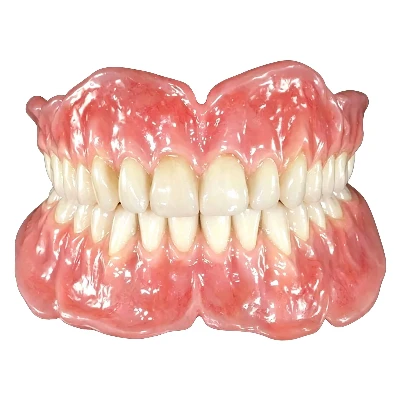
With 3D printing, the denture base can instead be produced directly from a digital design using an appropriate biocompatible resin.
Depending on the manufacturing system, denture teeth may then be bonded into the printed base, while newer multi-material manufacturing systems can produce the base and teeth as part of a more integrated production process.
Commercial multi-material systems have demonstrated workflows capable of producing the denture base and teeth in a single manufacturing operation. In suitable workflows, this can compress a traditional five-day production sequence to approximately 24 hours while eliminating several conventional flasking and processing steps.
Post-processing remains a critical part of the process. In particular, post-curing in digital denture fabrication can affect the final material properties and dimensional stability of printed denture components.
Crown and Bridge Frameworks
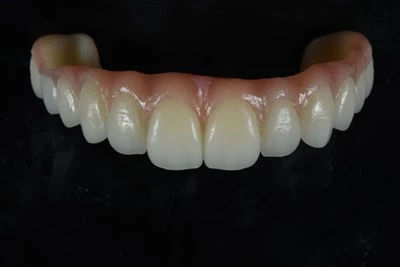
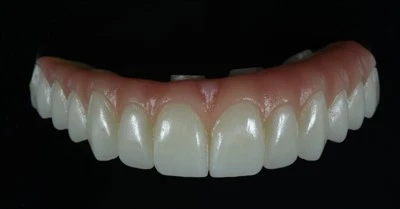
Metal 3D printing, particularly SLM, has changed how some dental laboratories manufacture crown and bridge frameworks and removable partial denture frameworks.
Cobalt-chrome frameworks produced through SLM have shown fatigue strength roughly 20% higher than cast equivalents according to data cited under YY/T 1702-2020, the Chinese national standard for additively manufactured dental metallic materials.
The standard classifies materials into five types according to application:
- Types 0–2 for single-unit restorations such as inlays and crowns
- Type 3 for multi-unit bridges
- Types 4–5 for removable partial dentures and higher-stress components
Typical dental 3D printing applications can therefore be summarized as follows:
|
Application |
Print Technology |
Typical Material |
Key Advantage |
|
Working models |
DLP / mSLA |
Model resin |
Reprintable and dimensionally stable |
|
Surgical guides |
SLA / DLP |
Biocompatible guide resin |
Sub-mm implant precision |
|
Night guards / splints |
DLP |
Flexible / durable resin |
Uniform thickness and consistent production |
|
Denture bases |
SLA / DLP |
Denture base resin |
Eliminates flasking and packing |
|
Crown & bridge frameworks |
SLM (metal) |
Co-Cr or titanium alloy |
~20% higher fatigue strength vs. casting |
|
Clear aligner models |
DLP / mSLA |
Model resin |
High-volume batch printing |
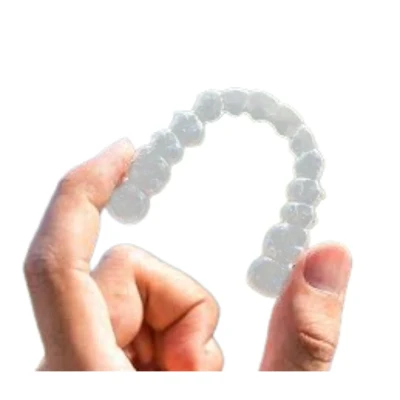
Clear Aligner Models
The clear aligner production workflow also relies heavily on 3D-printed dental models.
Each step in a conventional aligner treatment plan can require a physical model over which a thermoplastic sheet is vacuum-formed.
A high-throughput DLP printer can produce more than 100 models per build under suitable production conditions.
Direct printing of aligners themselves, which eliminates the thermoforming stage, is also undergoing clinical development. Printed aligners have demonstrated 36.8% lower thickness variability than thermoformed equivalents in cited data.

3D Printing vs. Milling in Dental Laboratories
3D printing and CNC milling are complementary manufacturing technologies rather than direct competitors.
The correct manufacturing method depends on several factors, including:
- Material
- Restoration type
- Geometry
- Production volume
- Required tolerances
- Mechanical performance
- Surface requirements
- Post-processing requirements
The comparison can be viewed as follows:
|
Factor |
3D Printing (Resin) |
CNC Milling |
|
Material waste |
Near zero because manufacturing is additive |
Higher because material is removed from a block |
|
Geometry freedom |
Supports undercuts and complex internal geometries |
Limited by tool access |
|
Surface finish |
Requires post-curing and polishing |
Directly machined surface |
|
Tolerance consistency |
±35–50 μm, resin-dependent |
±25–35 μm, machine-dependent |
|
Batch efficiency |
High; multiple parts can be nested in one build |
Generally processed by machining cycles |
|
Material range |
Photopolymer resins and metal powders |
Zirconia, titanium, PMMA, wax and other machinable materials |
|
Best suited for |
Models, guides, dentures and certain frameworks |
Monolithic zirconia crowns, bars and other milled restorations |
A useful production principle is to print where additive manufacturing offers a clear workflow advantage and mill where the material or clinical indication makes subtractive manufacturing more appropriate.
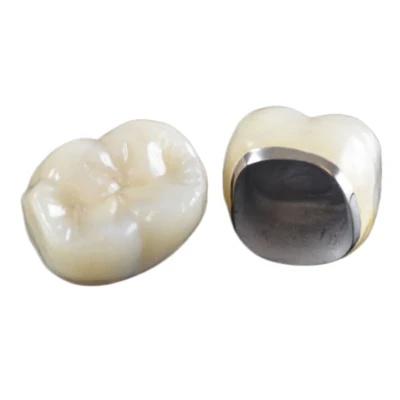
Monolithic zirconia crowns and full-contour bridges, for example, still commonly belong in the milling workflow because current resin or directly printed ceramic options do not provide the same combination of flexural strength and fracture toughness required for many posterior load-bearing restorations. A CAD/CAM zirconia crown is a good example of a restoration where milling remains central to the production process.
Models, surgical guides, denture bases, certain metal frameworks, and provisional restorations, however, are well suited to additive manufacturing.
The result is not a choice between dental milling and 3D printing, but a hybrid digital workflow in which each manufacturing method is used where it performs best.
Dental 3D Printing Materials and Regulatory Compliance
Dental Printing Resin Categories
Dental printing resins are application-specific materials rather than interchangeable generic photopolymers.
Each material is formulated for a particular production or clinical endpoint and may carry different regulatory requirements.
Common categories include:
- Model resins - Fast-printing, high-precision materials intended for working and diagnostic models rather than intraoral use.
- Surgical guide resins - Biocompatible materials intended for surgical guide applications and prolonged mucosal contact where permitted by the relevant regulatory clearance.
- Denture base resins - Biocompatible materials intended for denture base production and required to meet applicable denture base polymer standards such as ISO 20795.
- Crown and bridge resins - Permanent or provisional restorative materials developed for selected crown and bridge indications. A commercially available hybrid resin for permanent restorations received NMPA approval in 2026.
- Castable / burnout resins - Materials used for lost-wax casting patterns and designed to burn out cleanly with minimal residue.
Selecting the correct material is therefore part of the dental laboratory workflow itself, not simply a purchasing decision.
Regulatory Requirements for Printed Dental Devices
Printed dental products are regulated as medical devices in many markets.
In the United States, device requirements depend on classification and intended use. The FDA provides guidance on how manufacturers should classify a medical device, while applicable Class II products may require a Premarket Notification, or 510(k).
In the European Union, dental medical devices are governed by the EU Medical Device Regulation (MDR 2017/745), including requirements that may apply to custom-made dental products.
China regulates custom dental prostheses through the NMPA framework, while Australia applies its own medical device requirements through the TGA.
|
Jurisdiction |
Regulation |
Device Class |
Key Requirement |
|
United States |
FDA / 510(k) |
Class I–II |
Premarket requirements for applicable dental devices |
|
European Union |
MDR 2017/745 |
Class IIa for many dental applications |
Applicable conformity and regulatory requirements |
|
China |
NMPA registration |
Class II custom dentures |
Material registration and QMS compliance |
|
Australia |
TGA |
Class IIa |
ARTG entry and applicable conformity requirements |
The material itself may also have a specific clearance or intended use.
A resin intended only for producing diagnostic models should not automatically be used to produce a surgical guide simply because both materials are compatible with the same printer.
Dental laboratories therefore need to verify the intended application of the printer, material, production process, and finished device while maintaining appropriate documentation and traceability.
Common 3D Printing Workflow Challenges in Dental Laboratories
Purchasing a printer does not automatically create an efficient 3D printing dental lab workflow. Many of the most important challenges are operational rather than mechanical.
Workflow integration.
A printer that sits outside the normal CAD/CAM software chain can become a production bottleneck. Files may arrive in inconsistent formats, support structures may require additional manual preparation, and build preparation can consume valuable technician time.
Dental labs that integrate print preparation with their CAD design and production-management systems-or use software that streamlines nesting and slicing-can achieve better production efficiency.
Post-processing labor.
Printing itself may be fast, but the complete production process also includes washing, curing, support removal, finishing, and inspection.
In some applications, these steps can require more technician time than the actual printing cycle. Automated post-processing systems combining washing and UV curing have been reported to reduce post-processing labor by 60–95%.
Material validation and traceability.
Each printed dental device may require traceability for material lots, manufacturing parameters, and post-processing records.
These requirements are especially important in a professional dental laboratory operating under a structured quality management system. ISO 13485 provides an internationally recognized quality management framework for organizations involved in medical devices.
Laboratories moving from analog production to a fully digital dental laboratory workflow can underestimate how much documentation and production control are required.
Staff skill transition.
A dental technician experienced in waxing, casting, or conventional processing does not automatically have the same level of expertise in CAD design, digital file preparation, printer setup, and additive manufacturing.
Training therefore needs to develop alongside equipment investment.
Digital manufacturing can automate parts of production, but experienced dental technicians remain important for case assessment, finishing, aesthetics, occlusion, quality control, and other steps where technical judgment is still required.

Conclusion
3D printing fits into a modern dental laboratory workflow as an integrated manufacturing method within a broader digital CAD/CAM process. It is not simply a standalone machine, nor is it a wholesale replacement for milling, casting, or experienced dental technicians.
Its strongest applications include dental models, surgical guides, splints, denture components, selected frameworks, and other products where additive manufacturing provides advantages in geometry, repeatability, or batch production. Milling continues to play an important role for materials and restorations such as monolithic zirconia, while technician finishing and quality control remain essential throughout the workflow.
The most effective modern dental laboratories therefore combine digital case receiving, CAD/CAM design, 3D printing, milling, post-processing, technician craftsmanship, and structured quality control into a connected production system.
ADS Dental Laboratory Ltd (Aesthetic Dental Solutions) is a full-service digital dental laboratory based in Shenzhen, China, providing long-term dental lab outsourcing for dentists and dental laboratories worldwide. Our digital production capabilities include CAD/CAM design, digital scanning, milling, 3D printing, digital model production, case tracking, and structured quality control.
If you are evaluating whether a particular restoration, appliance, or outsourced production workflow is better suited to 3D printing, milling, or a combination of digital manufacturing methods, contact ADS Dental Laboratory Ltd to discuss your cases and production requirements with our team.
FAQ
What is 3D printing used for in a dental laboratory?
Dental laboratories use 3D printing for applications including diagnostic and working models, surgical guides, splints, night guards, denture bases, clear aligner models, temporary restorations, and certain metal frameworks. The appropriate application depends on the printing technology, material, clinical indication, and regulatory requirements.
Where does 3D printing fit into a digital dental laboratory workflow?
3D printing normally enters the workflow after digital data capture and CAD design. A typical process includes intraoral scanning or model scanning, CAD design, manufacturing through 3D printing or milling, post-processing, technician finishing, and quality control.
Is 3D printing replacing dental milling?
No. 3D printing and dental milling are complementary technologies. Printing is particularly useful for models, guides, appliances, dentures, and complex geometries, while milling remains important for materials such as zirconia, titanium, PMMA, and other restorations requiring specific mechanical properties.
Can dental laboratories 3D print permanent restorations?
Certain permanent dental restorations can be produced using approved additive manufacturing materials and technologies. However, the appropriate manufacturing method depends on the restoration type, material properties, mechanical requirements, and regulatory status of the material and process.
What should a dental lab consider before adding 3D printing to its workflow?
A dental laboratory should consider more than printer specifications. Important factors include CAD software integration, material selection, intended clinical indications, post-processing requirements, staff training, production traceability, quality control, regulatory compliance, and how the printer will interact with existing milling and conventional laboratory processes.
Sources
1.Dental 3D printing technology overview.
2.Dental 3D printing workflow reference.
3.Dental 3D printing and clear aligner production workflow reference.
4.Light-curing dental 3D printing process, equipment, and workflow guide.
5.Dental 3D printing production process overview.
6.Dental 3D printing modeling and manufacturing workflow guide.