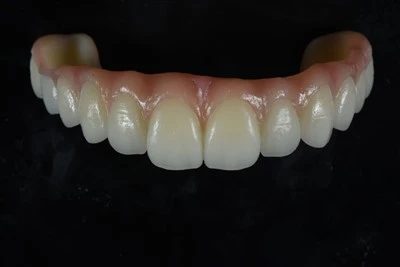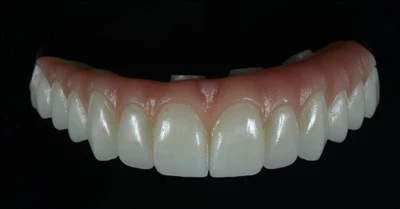
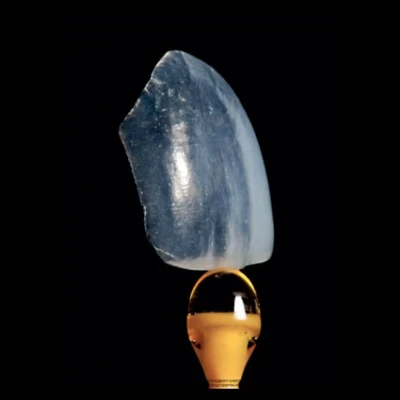
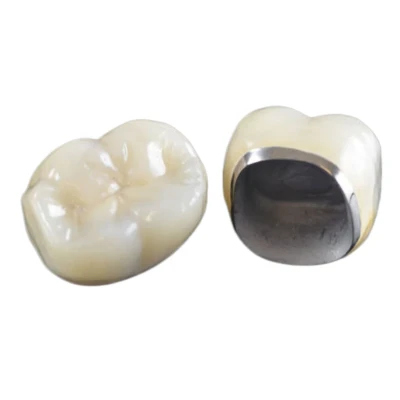
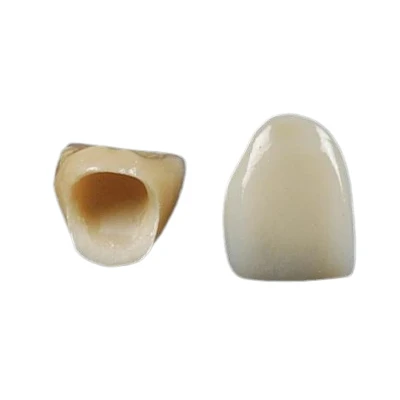
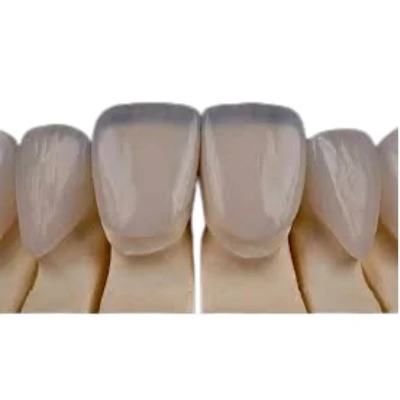
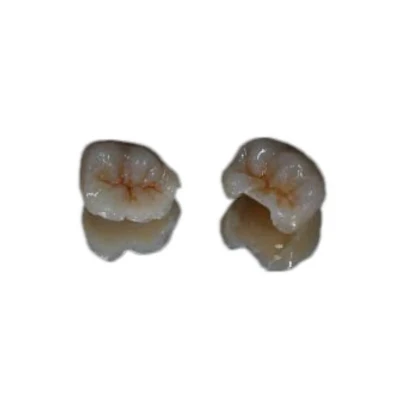
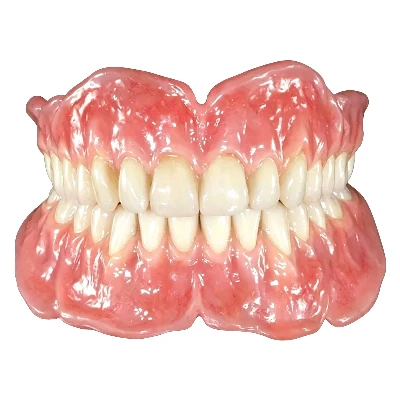


Hand-layered porcelain and monolithic crowns solve different clinical problems. Hand layering gives the technician greater control over internal color, translucency, incisal effects, and surface texture. Monolithic crowns remove the veneering-porcelain interface, which improves chip resistance and makes them better suited to many high-load cases.
Neither design is the automatic choice for every restoration. Tooth position matters, but so do occlusion, restorative space, substrate color, patient expectations, and the specific ceramic being used.

What Do Hand-Layered Porcelain and Monolithic Crowns Mean?
A hand-layered porcelain crown is built from a supporting substructure and a separate veneering ceramic. The substructure may be zirconia, metal, lithium disilicate, or another compatible ceramic. A technician applies porcelain in multiple layers to reproduce the optical structure of a natural tooth.
Those layers can represent different parts of the tooth:
- Higher-chroma dentin
- More translucent enamel
- Incisal effects
- Mamelons and halos
- White spots, crack lines, or other characterization
- Surface texture and luster
A monolithic crown has its full anatomical form made from one material. It does not have a separate porcelain veneer added over the occlusal or facial surface. The restoration may be milled or pressed, depending on the material.
"Monolithic" describes the structure, not a single ceramic.
Monolithic zirconia is the most common example in high-load cases, but lithium disilicate and other glass ceramics can also be used in monolithic form. Their mechanical properties are not the same. A monolithic 3Y zirconia crown should not be treated as equivalent to a monolithic lithium disilicate crown simply because both are single-material restorations.
For this reason, material selection must follow structural design-not replace it.
Hand-Layered vs. Monolithic Crowns: A Quick Comparison
The main differences are easier to understand when viewed side by side.
|
Factor |
Hand-Layered Porcelain |
Monolithic Crown |
|
Structure |
Substructure plus veneering porcelain |
Full contour made from one material |
|
Esthetic control |
High control over internal color and translucency |
Relies more on material gradient, staining, glazing, and texture |
|
Chip resistance |
Veneering porcelain may chip or delaminate |
No separate porcelain veneer to chip |
|
Strength |
Depends on both the core and veneering design |
Depends mainly on the selected material and thickness |
|
Fabrication |
More handwork and usually more firing steps |
More streamlined digital workflow |
|
Turnaround |
Usually longer |
Usually faster |
|
Typical use |
Complex anterior esthetic cases |
Posterior, implant, bruxism, and limited-space cases |
|
Cost |
Usually higher because of technician time |
Usually lower because of fewer fabrication steps |
This table gives a useful starting point, but tooth position alone should not determine the final choice.
A front tooth can still be a high-load restoration. A posterior crown can still require strong esthetics. The correct design comes from the complete case.
Where Hand-Layered Porcelain Has the Esthetic Advantage
Natural teeth do not have one uniform shade from the cervical area to the incisal edge. Dentin controls much of the tooth's chroma and opacity. Enamel modifies brightness, translucency, and the way light moves through the tooth.
Hand layering allows the technician to build those effects inside the restoration.
That internal control is especially important when matching a single maxillary central incisor. The neighboring tooth may have a translucent incisal third, a brighter facial line angle, subtle mamelons, areas of higher cervical chroma, and a specific surface texture. Surface staining alone may reproduce some visible color, but it cannot create the same depth as carefully placed internal ceramic layers.
Hand-layered porcelain is most valuable when:
- A single anterior crown must match natural adjacent teeth
- The neighboring dentition has complex translucency
- The patient has high esthetic expectations
- Incisal effects and internal characterization are important
- The restoration will be evaluated under different lighting conditions
- There is enough restorative space for a properly supported layered design
The skill of the technician still matters. A poorly planned layered crown is not automatically more natural than a well-designed monolithic crown. The final result also depends on shade photographs, stump shade, substrate color, ceramic thickness, and communication between the clinic and laboratory.
Modern high-translucency and multilayer zirconia can satisfy many routine anterior cases. Hand layering remains most valuable when the case requires precise control that a premanufactured shade gradient and external stain cannot fully provide.
Where Monolithic Crowns Have the Mechanical Advantage
The main mechanical advantage of a monolithic crown is structural simplicity. There is no separate veneering ceramic bonded to a stronger framework. This removes one of the most common weak points in layered restorations.
No Veneering-Porcelain Interface
A layered zirconia crown may have a strong zirconia substructure, but the veneering porcelain is still the more vulnerable part of the restoration. If the porcelain is poorly supported, too thick, unevenly fired, or placed under heavy functional contact, chipping risk increases.
A monolithic crown does not have that interface.
This is clinically important in:
- Molar restorations
- Bruxism cases
- Heavy occlusal contacts
- Posterior implant crowns
- Full-arch prostheses
- Patients with a history of porcelain chipping
The absence of veneering porcelain does not mean a monolithic crown cannot fail. Bulk fracture, marginal damage, loss of retention, support failure, and implant-component complications can still occur.
The design simply removes one specific failure mode.
Strength Depends on the Material
High-strength 3Y-TZP zirconia commonly has a reported flexural strength of approximately 900–1,200 MPa. Lithium disilicate materials are often reported at around 400 MPa.
These figures help explain why high-strength zirconia is widely used in posterior and implant cases. They do not mean every zirconia product performs identically.
Zirconia composition affects both strength and translucency. Traditional 3Y zirconia generally provides higher strength but lower translucency. Materials with more cubic-phase content, including many 4Y and 5Y formulations, usually provide better optical properties but lower strength than 3Y zirconia.
This trade-off matters in anterior monolithic crowns. A highly translucent zirconia may look better, but it should not automatically be selected for a high-load case.
Different Failure Patterns
Layered crowns may fail through:
- Small porcelain chips
- Larger veneer fractures
- Delamination
- Localized wear
- Microcracking at the veneer interface
Published clinical reports have described veneering-porcelain chipping rates in the approximate range of 5% to 15% over five years. The actual rate varies because studies use different definitions of chipping and include different restoration types, locations, support systems, and patient risk levels.
A small chip does not always require a remake. Some minor defects can be polished or repaired. Larger chips in functional or highly visible areas are more likely to require replacement.
Monolithic crowns avoid veneer chipping, but surface condition still matters. After occlusal adjustment, zirconia should be carefully repolished. A rough adjusted surface may increase wear on the opposing dentition.
Material hardness alone does not determine antagonist wear. Surface roughness is often more clinically relevant.
Which Crown Is Right for Different Clinical Cases?
The best design becomes clearer when the case is separated into clinical categories.
Anterior Single Crowns and Complex Shade Matching
For a single central or lateral incisor with complex neighboring teeth, hand-layered porcelain or selective facial layering is usually the stronger esthetic choice.
This is especially true when the case requires:
- Precise shade matching
- Incisal translucency
- Internal effects
- Strong surface characterization
- Control over brightness and chroma
- Matching under different light sources
The preparation must provide enough room for the supporting structure and porcelain without creating an overcontoured restoration.
For routine anterior cases with less demanding shade characteristics, multilayer monolithic zirconia may be sufficient. It can shorten production time and reduce veneer-related complications while still providing acceptable esthetics.
Posterior Crowns, Heavy Bites, and Bruxism
Posterior crowns are exposed to higher functional loads, especially in the molar region. For patients with bruxism, clenching, or a history of fractured porcelain, monolithic zirconia is usually the more reliable design.
The reason is direct: there is no veneering layer on the occlusal surface to chip.
That does not remove the need for careful occlusal design. A high-strength material cannot compensate for inadequate clearance, an unsupported margin, severe interferences, or poor adjustment.
Patients with bruxism may also benefit from a night guard after delivery. Material selection and occlusal management should work together.
Implant Crowns and Full-Arch Restorations
Posterior implant crowns often favor a monolithic design because implants do not have the same periodontal-ligament movement as natural teeth. Load transfer is different, and the restoration may be less forgiving of concentrated contacts.
Monolithic zirconia can reduce the risk of veneering-porcelain chipping in these cases.
Full-arch restorations require a broader assessment. The design should consider:
- Implant position
- Connector dimensions
- Cantilever length
- Restorative space
- Opposing dentition
- Screw-access position
- Occlusal scheme
- Parafunction
A full-arch prosthesis does not have to be completely monolithic or fully layered. Many cases use a monolithic base with selective facial or incisal characterization where esthetics matter most.
Limited Restorative Space or Previous Chipping
A layered crown needs space for both the framework and the veneering porcelain. When the available clearance is limited, the porcelain may become too thin, uneven, or poorly supported.
That is a poor reason to force a layered design.
Selected high-strength monolithic zirconia systems can sometimes be used with more conservative preparation. Minimum thickness should still follow the material manufacturer's instructions and the actual loading conditions of the case. A single universal thickness value does not apply to all zirconia types.
Previous chipping is also important. It may indicate bruxism, inadequate clearance, heavy contacts, poor veneer support, or an unsuitable earlier design. The cause should be evaluated before selecting the replacement restoration.

The Middle Ground: Multilayer Zirconia, Cutback, and Micro-Layering
The choice is no longer limited to fully monolithic or fully layered crowns.
Modern digital dental laboratories can combine both approaches.
Multilayer Monolithic Zirconia
Multilayer zirconia includes a built-in transition in shade, translucency, or both. The cervical area may appear more chromatic, while the incisal area is more translucent.
This improves esthetics without adding a separate porcelain veneer.
Multilayer monolithic zirconia works well for many routine anterior crowns, premolars, and cases where the patient wants a natural appearance without accepting the additional chipping risk of full layering.
The final result still depends on contour, staining, surface texture, glazing, and polishing.
Facial Cutback and Selective Micro-Layering
A facial cutback crown keeps most of the restoration monolithic but creates controlled space for porcelain on the facial or incisal surface.
This design offers two advantages:
- Functional areas remain largely monolithic
- Visible areas gain greater optical depth
Selective micro-layering is often a practical choice for anterior cases that need more than stain and glaze but do not require full porcelain coverage.
The cutback must be designed correctly. Unsupported porcelain, sharp internal angles, or excessive veneer thickness can increase fracture risk.
Combination Designs Across the Arch
A multi-unit or full-arch case may use different designs in different regions.
Posterior units can remain monolithic for strength. Anterior units may receive facial cutback, incisal micro-layering, or more extensive characterization.
This approach follows the actual demands of each area instead of applying one material philosophy across the entire arch.
Preparation, Digital Workflow, and Lab Communication
Material selection alone does not produce a predictable crown. Preparation, digital design, ceramic processing, and clinical information all influence the outcome.
Restorative Space and Preparation
Layered restorations require adequate room for both the framework and veneering ceramic. If the preparation does not provide that space, the laboratory may be forced to choose between an overcontoured crown and an inadequately supported porcelain layer.
Monolithic zirconia may allow a more conservative design in selected cases, but the required thickness depends on:
- Zirconia composition
- Tooth position
- Occlusal load
- Margin design
- Restoration span
- Manufacturer recommendations
The safest approach is to choose the intended material before finalizing the preparation whenever possible.
How the Digital Workflow Supports Both Designs
Both crown types can begin with the same digital foundation:
- Receive the intraoral scan or digitized impression
- Review margins, contacts, occlusion, and restorative space
- Design the full-contour crown or cutback framework
- Mill the zirconia or other ceramic
- Complete sintering or crystallization
- Apply stain, glaze, polish, or hand-layered porcelain
- Inspect fit, contact, occlusion, shade, and surface quality
Digital design can reduce some variables associated with manual patterning and model transfer. It does not eliminate judgment.
Scan quality, margin identification, CAD parameters, milling accuracy, sintering control, finishing, and quality inspection still determine whether the crown performs well.
What the Dental Lab Needs From the Clinician
For high-esthetic anterior cases, the laboratory should receive more than a shade number.
Useful records include:
- Full-face photograph
- Smile photograph
- Retracted frontal photograph
- Close-up photographs with a shade tab
- Stump shade or prepared-tooth photograph
- Notes on translucency and brightness
- Requested surface texture
- Incisal characterization
- Information about the opposing teeth
For posterior, implant, and high-load cases, the prescription should also include:
- Bruxism or clenching history
- Previous chipping or fracture history
- Available occlusal space
- Opposing restorative material
- Implant and screw-access information
- Functional contacts
- Night-guard use
Good laboratory communication often prevents the wrong material from being selected before production begins.

Conclusion
Hand-layered porcelain is the better choice when the case demands precise control over internal color, translucency, incisal effects, and neighboring-tooth characterization. Monolithic zirconia is usually the stronger option when occlusal load, limited space, implant support, bruxism, or resistance to porcelain chipping is the main concern.
Many cases fall between those two extremes. Multilayer zirconia, facial cutback, and selective micro-layering can provide a practical balance of strength and esthetics.
ADS Dental Laboratory Ltd is a China-based digital dental laboratory providing long-term custom restoration outsourcing services for overseas dentists and dental laboratories. Send us your scans, shade photographs, and case requirements to discuss the most suitable monolithic, cutback, micro-layered, or fully layered solution.
FAQ
Are Monolithic Crowns Always Stronger?
No. Monolithic crowns do not all use the same material. High-strength 3Y zirconia is much stronger than many glass ceramics, but high-translucency zirconia and lithium disilicate have different mechanical properties. Monolithic design improves structural simplicity, but the actual strength still depends on the ceramic.
Do Hand-Layered Crowns Always Look More Natural?
No. Hand layering provides more control over internal optical effects, but the result depends on the technician, material, preparation, substrate color, and clinical records. A well-made multilayer zirconia crown can look better than a poorly planned layered crown.
Can Monolithic Zirconia Be Used for Anterior Teeth?
Yes. Modern high-translucency and multilayer zirconia can work well in many anterior cases. A highly demanding single-incisor match may still benefit from facial cutback or hand layering.
Which Crown Is Better for Bruxism?
Monolithic zirconia is usually the safer choice because it eliminates the veneering-porcelain layer. The restoration still needs adequate thickness, proper occlusion, smooth polishing, and, when appropriate, protection with a night guard.