

Dental practices and dental laboratories face the same production question sooner or later: should restorations be made in-house, or should part of the work be outsourced to a dental lab?
The answer is not only about price.
It affects cash flow, turnaround time, technician workload, remake rate, equipment use, patient experience, and long-term growth. A small clinic trying to control crown costs has a different problem from a local dental lab handling overflow cases. A large practice with steady single-unit crown volume has a different calculation from a lab that receives complex implant cases in uneven batches.
This article compares dental lab outsourcing and in-house production from a practical manufacturing point of view, so you can decide which model fits your business.

Quick Answer: Which Model Makes More Sense?
Dental lab outsourcing usually makes more sense when you want lower fixed costs, flexible production capacity, and access to a wider range of technical capabilities without building a full production department.
In-house production makes more sense when case volume is stable, you have trained technicians, enough space, and a clear need for fast chairside response or direct process control.
For many dental practices and small to mid-sized dental labs, the best answer is a hybrid model: keep simple, urgent, or highly patient-facing adjustments in-house, and outsource high-volume, complex, or equipment-heavy production.
A simple rule works well:
|
Business Situation |
Better Fit |
|
Low or unstable case volume |
Dental lab outsourcing |
|
Stable high monthly volume |
In-house production may work |
|
Frequent urgent chairside adjustments |
In-house production |
|
Need broader case range without buying more equipment |
Outsourcing |
|
Limited technician availability |
Outsourcing |
|
Strong technical team and enough space |
In-house production |
|
Growth stage with changing demand |
Hybrid model |
The model should protect four things: restoration quality, delivery time, cash flow, and customer trust.
What Dental Lab Outsourcing and In-House Production Really Mean
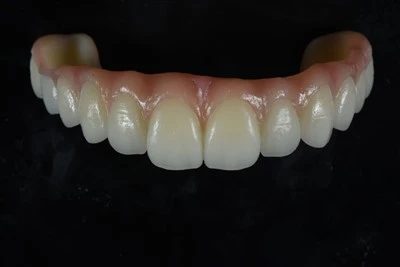
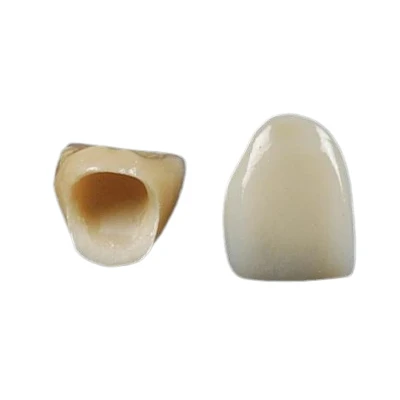
Dental lab outsourcing means sending part or all of the restoration workflow to an external dental laboratory. This may include CAD design, milling, 3D printing, sintering, staining, glazing, implant restoration production, finishing, quality control, and final delivery.
Modern outsourcing is no longer just shipping physical impressions and waiting. In many cases, the workflow starts with digital files. A clinic or lab sends STL, PLY, OBJ, intraoral scan files, or model scan files. The outsourcing dental lab checks the files, designs the restoration, produces the case through CAD/CAM equipment, completes finishing and QC, then ships the final restoration.
This is common for:
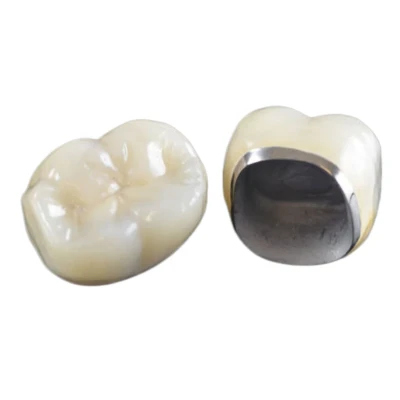
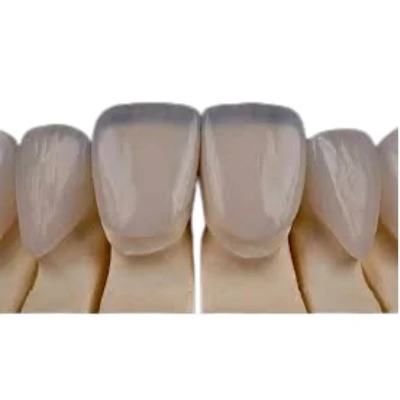
- Zirconia crowns and bridges
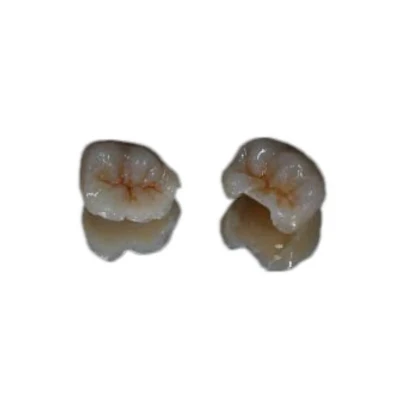
- E.max restorations
- Implant crowns
- Screw-retained implant restorations
- Custom abutments
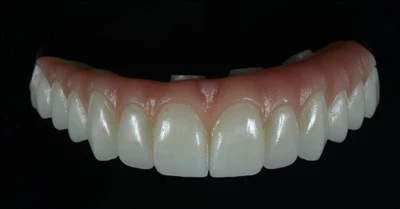
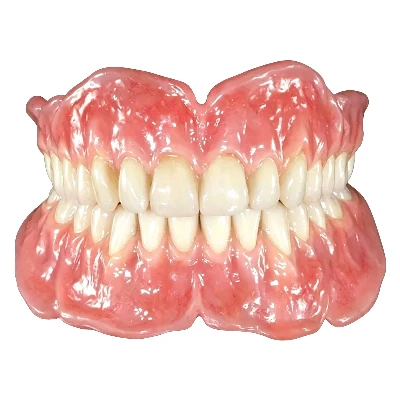
- Full-arch cases
- Night guards
- CAD/CAM design and production
- Overflow crown and bridge cases
In-house production means building production capacity inside your own clinic or dental lab. This may be a small chairside system for simple crowns, or a larger production area with scanners, design software, milling machines, 3D printers, furnaces, sintering ovens, staining and glazing stations, and trained technicians.
Building an in-house dental lab means building a production department, not just buying equipment.
A realistic in-house setup often requires:
|
Requirement |
Typical Examples |
|
Digital equipment |
Intraoral scanner, model scanner, CAD software, CAM software |
|
Production equipment |
Milling machine, 3D printer, sintering furnace, ceramic furnace |
|
Staff |
CAD designer, dental technician, finishing technician, QC person |
|
Materials |
Zirconia discs, lithium disilicate blocks, resins, implant components |
|
Space |
Workbench area, equipment area, storage, ventilation |
|
Management |
Maintenance, calibration, training, remake tracking, material control |
Even a basic digital production setup can require a serious budget. Depending on the brand and configuration, a scanner may cost thousands to tens of thousands of dollars, a milling unit may range from around $30,000 to well above $100,000, and furnaces, software, tools, burs, materials, and maintenance add more cost over time.
This is why the outsourcing vs. in-house decision should be based on total production reality, not only unit price.

Dental Lab Outsourcing: Main Pros and Cons
Pros of Dental Lab Outsourcing
The first advantage of dental lab outsourcing is lower fixed cost.
A practice or local lab does not need to buy every machine, hire every specialist, stock every material, or maintain every production line. This matters when case volume changes month by month. If you only produce 30 to 50 units per month, a full in-house CAD/CAM setup may sit idle too often to justify the investment.
Outsourcing also makes production cost easier to forecast. Instead of paying for equipment depreciation, technician salaries, software updates, repairs, and unused materials, you pay by case or by unit. That does not always mean the lowest price, but it often gives better cost control.
A second advantage is capacity.
A mature outsourced dental production partner can absorb overflow when a clinic or lab is busy. This is especially useful for local dental laboratories that receive seasonal spikes, large crown and bridge batches, or implant cases beyond their internal capacity.
The third advantage is technical range.
A small in-house setup may handle basic crowns well but struggle with complex implant restorations, full-arch cases, advanced staining, multi-layer zirconia, or custom abutments. A specialized dental lab outsourcing partner may already have dedicated teams for different case types.
That changes the business calculation. You are not only buying production. You are accessing a wider production system.
For dental practices, outsourcing also allows the clinical team to focus on patient care. For local dental labs, it can free internal staff to focus on customer communication, design review, shade management, and high-value cases instead of being buried in routine production.
Cons of Dental Lab Outsourcing
Outsourcing has risks, and they should not be ignored.
The most common problem is communication. A crown may fail not because the milling machine was poor, but because the instructions were incomplete. Margin design, occlusal clearance, contact tightness, shade requirements, implant system information, emergence profile, and material choice all need to be clear.
If the case instruction is vague, the remake risk goes up.
Turnaround time is another concern. With outsourcing, the timeline includes file checking, communication, production, QC, packing, and shipping. For overseas dental lab cooperation, logistics must be planned properly. Outsourcing is not ideal for every same-day emergency adjustment.
There is also less direct control. When production is outside your building, you cannot walk into the lab and check the case immediately. The solution is not to avoid outsourcing completely. The solution is to choose a dental lab partner with clear workflow, stable communication, and strict quality control.
Data security also matters. Digital dental files may include patient-related information. When working with an external or overseas dental lab, clinics and labs should confirm how files are transferred, who can access them, and whether confidentiality terms are needed.
Outsourcing works best when it is treated as a managed partnership, not a casual transaction.
In-House Production: Main Pros and Cons
Pros of In-House Production
The strongest advantage of in-house production is direct control.
When design, production, adjustment, and finishing happen inside the practice or lab, communication is faster. A dentist can speak directly with the technician. A technician can check shade, contour, or contact point without waiting for several emails. For esthetic cases, urgent adjustments, temporaries, and simple chairside corrections, this can be a real advantage.
In-house production can also improve patient experience in selected situations. If a practice can deliver a simple restoration faster, reduce appointments, or handle a small repair on-site, patients notice.
For larger practices, DSOs, or high-volume dental laboratories, an in-house lab can become part of the business asset. It may support brand control, internal training, technical development, and consistent production standards.
But this only works when the volume and team are there.
If a practice buys a mill but lacks a skilled designer, the equipment will not solve the problem. If a lab owns a furnace but cannot retain technicians, quality will still vary. Production quality comes from people, process, equipment, and case selection working together.
Cons of In-House Production
The main disadvantage is cost.
Initial investment can include scanners, CAD/CAM software, milling machines, 3D printers, furnaces, dust collection, sintering equipment, finishing tools, and materials. Then comes maintenance, software updates, burs, calibration, repairs, and replacement parts.
Staffing is often the harder issue. Skilled dental technicians and CAD designers are not easy to recruit or train. A good designer can affect margin fit, occlusion, anatomy, contact strength, and remake rate. Losing one key technician can disrupt production faster than losing one piece of equipment.
Space is another limit. Many dental practices simply do not have enough room for a proper in-office lab. Equipment needs work areas, storage, ventilation, power, and a clean workflow. Older clinics may need renovation before production can be added.
Then there is idle capacity.
If you build for peak volume, machines and staff may sit underused during slower months. If you build for average volume, the team may still be overloaded during busy periods. This is one reason many practices and labs think in-house production will be cheaper, but later discover the real unit cost is higher than expected.
In-house production rewards stable volume. Without stable volume, it can turn into a fixed-cost burden.

Side-by-Side Comparison: Cost, Control, Quality, and Capacity
The choice becomes clearer when the two models are compared by operating factors.
|
Factor |
Dental Lab Outsourcing |
In-House Production |
|
Initial investment |
Lower |
Higher |
|
Labor cost |
Lower fixed labor burden |
Requires hiring and training |
|
Cost predictability |
Usually clearer with per-case pricing |
Depends on volume and equipment use |
|
Workflow control |
Less direct |
Stronger direct control |
|
Urgent response |
Slower for same-day adjustments |
Better for local urgent cases |
|
Capacity flexibility |
Stronger for overflow and growth |
Limited by staff, machines, and space |
|
Case variety |
Broader if the partner is capable |
Limited by internal setup |
|
Quality consistency |
Depends on partner workflow and QC |
Depends on internal team and standards |
|
Data control |
Requires secure vendor process |
Easier to keep internal |
|
Best fit |
Flexible growth, overflow, cost control |
Stable volume, direct control, fast local response |
Neither model is automatically better.
Outsourcing is not always slower. A well-organized digital dental lab can handle routine CAD/CAM cases efficiently. In-house production is not always cheaper. If the case volume is too low or the team is inexperienced, the real cost per unit can become high.
The deciding factor is not ownership of equipment. The deciding factor is whether the production system can deliver stable restorations at the right cost and speed.
How to Choose the Right Model for Your Practice or Lab
Choose Dental Lab Outsourcing If...
Choose dental lab outsourcing if your case volume is uneven, your technical team is limited, or your business is growing faster than your production capacity.
This is common for:
- Clinics that do not want to carry full lab overhead
- Small dental labs with overflow crown and bridge work
- Labs that need support for implant restorations or full-arch cases
- Practices that want to avoid large CAD/CAM investment
- Businesses that want predictable case-based production cost
A dental practice producing only a small number of crowns per month may not need a complete in-house system. A local lab that receives sudden batches from dentist clients may not want to hire extra technicians for peak months only. In these cases, outsourcing protects cash flow and gives more flexibility.
Outsourcing is also a strong option when you want to offer more restoration types without buying every machine or training every specialist.
Choose In-House Production If...
Choose in-house production if you have stable monthly volume, skilled people, enough space, and a clear reason to keep control close to the clinical or customer team.
This model can make sense for:
- High-volume clinics with repeatable crown workflows
- Larger dental labs with steady production demand
- Practices that need fast chairside service
- Teams with strong CAD/CAM knowledge
- Businesses that want to build long-term technical capability
For example, if a practice places a high number of same-day crown cases every week and has trained staff to design, mill, stain, and finish them, in-house production may support the service model.
But if the goal is only "to save lab fees," the decision needs more review. Lab fees are visible. Internal production costs are often hidden across payroll, training, repairs, remakes, materials, and unused capacity.
Consider a Hybrid Model If...
A hybrid model is often the most practical choice.
The internal team can keep work that needs fast local response, while an outsourcing dental lab handles complex, high-volume, or equipment-heavy cases.
A common split looks like this:
|
Keep In-House |
Outsource |
|
Minor adjustments |
Zirconia crowns and bridges |
|
Temporary restorations |
E.max restorations |
|
Simple urgent repairs |
Implant crowns |
|
Shade checks with patient present |
Custom abutments |
|
Chairside modifications |
Screw-retained restorations |
|
Basic design review |
Full-arch or overflow CAD/CAM production |
This model gives control where control matters most, and flexibility where capacity matters most.
For many growing practices and dental labs, hybrid production is not a compromise. It is the most stable operating model.
How to Evaluate a Dental Lab Outsourcing Partner
The cheapest outsourcing option is rarely the safest choice.
A reliable dental lab outsourcing partner should reduce production pressure without creating new problems in communication, remake handling, or quality consistency.
Start with the digital workflow. A capable digital dental lab should be able to receive STL, PLY, OBJ, intraoral scan files, or model scan files. It should check file quality before production and communicate early when margins, occlusion, scan gaps, bite records, or implant information are unclear.
Then look at quality control. For fixed restorations, the lab should check margins, contacts, occlusion, shade, surface finish, fit, and restoration design before shipping. For implant cases, the lab should also pay attention to implant system compatibility, screw access channel, emergence profile, tissue support, and passive fit.
Remake policy matters as well. No dental lab can promise zero remakes. What matters is how problems are reviewed, documented, corrected, and prevented from repeating.
Communication should be stable. This is especially true when working with an overseas dental lab. You need clear contact points, case instructions, expected turnaround times, rush case rules, shipping schedules, and feedback channels.
Before building a long-term relationship, send trial cases. Test routine crowns first, then more complex cases. Compare fit, shade, contact, occlusion, packaging, communication speed, and remake handling.
A good outsourcing partner should be evaluated by consistency, not by one perfect sample case.
Final Recommendation: Outsourcing, In-House, or Hybrid?
The right answer depends on the production problem you are trying to solve.
If you have stable high volume, trained technicians, enough space, and the need for close chairside control, in-house production can work well. If you need lower fixed costs, broader technical support, and flexible capacity, dental lab outsourcing is often the more practical route. If you want both control and scalability, a hybrid model usually gives the best balance.
The goal is not to own every step. The goal is to deliver consistent restorations without overloading your team, cash flow, or customers.
For overseas dentists and dental laboratories looking for stable production support, ADS Dental Laboratory Ltd provides digital dental lab outsourcing for customized restorations, including crowns, bridges, implant restorations, and CAD/CAM-based cases. If you are evaluating whether outsourcing can fit your workflow, our team can review your case types and discuss a practical cooperation model.