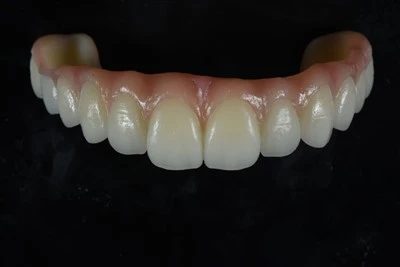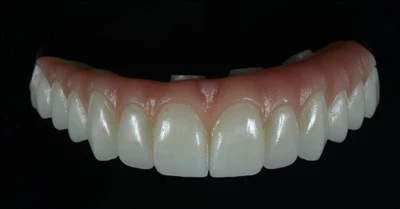
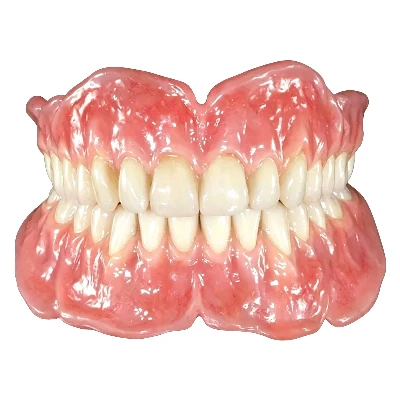

All-on-4 and All-on-X are both fixed full-arch implant concepts, but they do not create the same prosthetic environment. Implant number, distribution, angulation, posterior support, and restorative space all influence how the final implant-supported full arch bridge should be designed.
For dentists, the practical difference is how each implant configuration affects cantilever control, framework design, screw access, material selection, occlusion, passive fit, and long-term maintenance.

All-on-4 vs. All-on-X: What Actually Changes Prosthetically?
All-on-4 is a defined full-arch treatment concept using four implants per arch. A common configuration uses two relatively axial anterior implants and two tilted posterior implants. Tilting the posterior implants helps engage available bone, increase anterior-posterior spread, and reduce the need for extensive posterior grafting in selected cases.
All-on-X is a broader full-arch approach in which the number and position of implants can be adapted to the patient's anatomy, bone quality, functional demands, and restorative plan. In clinical use, this may involve four, five, six, or more implants. The defining feature is flexibility in implant configuration rather than one standardized implant count.
From the prosthetic side, this distinction matters because support geometry changes with implant position.
|
Prosthetic Factor |
All-on-4 |
All-on-X |
|
Implant number |
Fixed at 4 |
Variable |
|
Posterior support |
Often created through tilted distal implants |
May include additional posterior implants |
|
Cantilever |
Common and must be controlled |
Can often be reduced if implants are positioned farther posteriorly |
|
Framework demand |
Strong focus on rigidity and cantilever resistance |
May benefit from shorter unsupported spans |
|
Screw access |
Strongly influenced by tilted implants and MUA correction |
Depends on implant number and distribution |
|
Material selection |
Driven by load, space, framework design |
May become more flexible with improved support |
|
Hygiene |
Depends on intaglio design and implant access |
More implant sites may increase cleaning complexity |
The number of implants is only part of the prosthetic equation. Their position across the arch is usually more important.
Implant Distribution, AP Spread, and Cantilever: The Most Important Difference
Implant Number Is Not the Same as Implant Distribution
A six-implant restoration does not automatically have better prosthetic support than a four-implant restoration.
Consider two simplified cases. In the first, four implants are well distributed and the distal implants create a favorable anterior-posterior spread. In the second, six implants are concentrated in the anterior part of the arch. Although the second case has more implants, the distal unsupported span may remain almost unchanged.
This is why additional implants are most valuable when they improve the support geometry of the prosthesis.
In All-on-X treatment planning, placing another implant close to an existing anterior implant may increase implant count without producing a meaningful reduction in cantilever. Moving usable support farther posteriorly can make a much larger prosthetic difference.
Why AP Spread Matters
Anterior-posterior spread, or AP spread, describes the front-to-back distribution of the supporting implants. It directly influences how far the prosthesis extends behind the distal implants.
A longer distal extension creates a greater bending moment during posterior loading. This affects the framework, screws, implant-abutment interfaces, and the implant-bone system.
All-on-4 designs commonly incorporate a distal cantilever. A posterior cantilever of approximately 10–15 mm may be seen in typical designs, although the clinically acceptable length depends on arch form, implant position, AP spread, opposing dentition, and occlusal load.
When Additional Implants Can Reduce Cantilever
An additional posterior implant can shorten the unsupported span and move functional support closer to the posterior occlusal table. This may reduce framework flexure and improve load distribution.
The location of that implant matters more than the fact that it is the fifth or sixth implant.
Biomechanical observations also support the value of wider implant distribution, especially when posterior support reduces unsupported span and off-axis loading. This is one reason a well-planned All-on-X implant bridge should be evaluated according to support geometry rather than implant count alone.
For full-arch prosthetic planning, a useful rule is simple: additional implants provide the greatest value when they improve effective support in clinically meaningful positions.
Framework Design and Material Selection
Framework design should follow the support geometry of the arch.
In an All-on-4 case with a distal cantilever, the framework must resist repeated bending under posterior loading. Cross-sectional dimensions, connector design, passive fit, material rigidity, and the amount of restorative space therefore deserve close attention.
All-on-4 Framework Considerations
Materials used for full-arch restorations may include titanium, cobalt-chromium, zirconia, and selected high-performance polymers. The appropriate choice depends on the prosthetic design rather than the treatment name.
With four implants, especially where posterior cantilever is significant, the design should prioritize:
- Adequate framework rigidity;
- Sufficient material thickness;
- Passive seating across all implant interfaces;
- Controlled screw-access positions;
- Resistance to fatigue under repeated functional loading.
Titanium remains useful when high strength is required within a relatively limited framework section. Zirconia offers excellent rigidity and esthetics but requires adequate restorative space and thoughtful connector dimensions.
For cases where zirconia is selected as the definitive material, the design of an All-on-4 zirconia bridge should account for cantilever length, framework bulk, opposing dentition, and functional load.
All-on-X and Shorter Unsupported Spans
When additional implants improve posterior support, the distance between support points can decrease. This can reduce flexural demand on the superstructure and may make certain restorative options easier to engineer.
Monolithic zirconia, for example, can be an attractive definitive material when there is sufficient vertical and horizontal space, adequate support, and a suitable opposing dentition. Some implant distributions may also make segmented restorative designs practical.
Restorative space remains one of the most important design variables. A full-arch prosthesis has to accommodate some combination of:
- Framework thickness;
- Tooth height;
- Gingival replacement;
- Zirconia bulk;
- Acrylic or composite volume;
- Screw-channel access;
- Cleansable tissue contours.
A favorable implant count does not compensate for insufficient prosthetic space.

Implant Angulation, Multi-Unit Abutments, and Screw-Access Position
The posterior implants in classic All-on-4 configurations are commonly tilted, often within a range of approximately 30–45 degrees. This strategy helps use available bone, avoid certain anatomical limitations, and increase AP spread. The biomechanical and surgical rationale for tilted posterior implants in the All-on-4 concept has been widely discussed in the implant literature.
For the restorative dentist and laboratory, implant angulation becomes a prosthetic issue at the abutment level.
Multi-unit abutments, or MUAs, are used to create a more favorable restorative platform and correct implant divergence. The chosen MUA angle and height influence the final restorative axis, framework seating, emergence profile, and screw-access position.
A surgically stable implant can still create an inconvenient restorative position if the screw channel emerges too far facially, too close to an incisal edge, or through an unfavorable occlusal surface.
This is especially relevant in the anterior region, where screw-access location can affect esthetics, and in posterior regions, where access must remain practical for tightening, retrieval, and maintenance.
For this reason, full-arch planning should include the intended prosthetic envelope before implant placement whenever possible. Implant trajectory, MUA selection, tooth position, gingival replacement, and framework design work best when they are planned as one system.
Occlusion and Functional Load
Full-arch implant prostheses do not have the same proprioceptive response as natural dentition, so occlusal control matters.
In All-on-4 restorations with a posterior cantilever, the objective is usually to limit excessive off-axis forces and avoid overloading unsupported distal segments. Posterior contacts, excursive contacts, and anterior guidance should be designed with the implant distribution and opposing dentition in mind.
More conservative occlusal concepts are commonly used in All-on-4 cases, including reduced lateral loading and protection of cantilevered posterior segments.
Additional posterior support in an All-on-X configuration can allow the occlusal table to be supported more directly. That does not remove the need for occlusal control. It changes how forces can be distributed.
Opposing dentition makes a major difference.
A full-arch implant prosthesis opposing a complete denture experiences a different loading environment from the same restoration opposing natural posterior teeth. A patient with severe bruxism and an opposing zirconia full arch presents another level of mechanical demand.
In high-load cases, the design should be reviewed as a system:
implant distribution + cantilever + framework + material + occlusion
Bruxism, heavy masticatory forces, and unfavorable opposing dentition are strong reasons to evaluate whether additional posterior support can create a meaningful biomechanical advantage. Laboratory mounting and predictable occlusion with dental articulators can also help the restorative team evaluate contacts and functional relationships before delivery.
Digital Workflow and Passive Fit
Accurate implant position is critical in every rigid full-arch prosthesis.
A typical digital or hybrid workflow may involve intraoral scanning, implant scan bodies, conventional splinted impressions, photogrammetry, verification jigs, printed or milled prototypes, and CAD/CAM fabrication. The exact combination depends on the clinical situation and the laboratory workflow.
Capturing Implant Positions Accurately
Recording six implants is not inherently easier than recording four.
As the restoration spans the arch, positional inaccuracies can accumulate. The definitive framework still has to seat accurately across every connected implant or MUA.
That is why passive fit remains critical in both All-on-4 and All-on-X restorations.
For complex full-arch cases, verification may include:
- Cross-arch digital records;
- Photogrammetry;
- Splinted impression techniques;
- Verification jigs;
- Prototype seating;
- Radiographic or clinical verification before final fabrication.
For clinicians using digital records, understanding what dental labs need from an intraoral scan can help reduce avoidable errors in scan-body capture, tissue records, occlusion, and case submission.
The goal is not to rely on one technology. The goal is to establish that the digital or conventional record accurately reproduces the intraoral implant relationship.
Provisional, Prototype, and Definitive Restoration
Both protocols can be used with immediate provisionalization when primary stability and the clinical conditions support immediate loading. All-on-4 is especially well established in immediate-loading workflows.
A common sequence is:
Surgery → screw-retained provisional → healing → definitive records → prototype or verification → definitive prosthesis
A typical period of 3–6 months may be used before definitive conversion, although timing varies with healing, loading protocol, implant stability, and the clinical plan.
The provisional restoration is also a useful source of information. It can help evaluate tooth position, VDO, phonetics, lip support, smile line, occlusion, and hygiene access before the definitive prosthesis is manufactured.
Maintenance, Complications, and the Redundancy Trade-Off
Mechanical complications in full-arch prostheses can include acrylic fracture, veneering material fracture, screw loosening, framework-related problems, and wear. Cantilever flexure and heavy functional loading can increase mechanical demand.
Additional implants can provide redundancy. If one implant develops a problem, the remaining implant distribution may offer more options for managing the case than a four-implant configuration.
There is a trade-off. More implants also mean:
- More implant or MUA interfaces;
- More screws;
- More access channels;
- More tissue areas requiring hygiene access;
- Greater coordination during impression or scan capture.
The intaglio surface should therefore be designed for cleaning from the beginning. Convex contours, adequate tissue clearance, accessible embrasures, and retrievability are important parts of full-arch prosthetic design.
Published clinical data have reported All-on-4 implant survival above 94% at one-year follow-up, with tilted and axial implants capable of performing comparably when the protocol is properly executed.
From a maintenance perspective, the useful question is whether the chosen implant configuration reduces meaningful mechanical risks without making hygiene and service unnecessarily difficult.

How Should Dentists Choose Between All-on-4 and All-on-X?
The choice should start with anatomy and end with the definitive prosthesis.
When All-on-4 May Be the More Logical Configuration
All-on-4 remains a strong option when posterior bone is limited and a favorable AP spread can be achieved with tilted implants. It is particularly useful in cases where avoiding extensive posterior grafting is desirable and the clinical team already has a predictable immediate-load workflow.
The concept is well established and can produce reliable full-arch rehabilitation with only four implants when case selection, surgical execution, framework design, and occlusion are well controlled.
When Additional All-on-X Support May Be Valuable
Additional implants are worth considering when usable posterior bone is available and those implants can materially improve distal support.
They may be especially useful in cases involving:
- Heavy functional demand or bruxism;
- Long posterior spans;
- A desire to reduce cantilever;
- Broad arches with favorable posterior anatomy;
- Restorative designs that benefit from additional support;
- Definitive zirconia restorations where reduced unsupported span is desirable.
The treatment plan should still be prosthetically driven. Six implants clustered too far anteriorly may offer less practical benefit than four implants with excellent AP distribution.
What the Dental Lab Needs Before Designing the Prosthesis
Complex full-arch cases are easier to manage when the laboratory receives complete restorative information from the beginning.
Useful records include:
- Implant system and platform;
- Implant or MUA positions;
- MUA angle and collar height;
- Scan-body information;
- STL or other digital records;
- Jaw relation and VDO;
- Midline and smile line;
- Tooth and gingival shade;
- Opposing dentition;
- Provisional reference;
- Material preference;
- Relevant parafunctional history.
These details allow the laboratory to evaluate framework space, screw-channel emergence, implant distribution, cantilever, tooth position, occlusion, and hygiene before the definitive prosthesis is manufactured. Complete records also help reduce remakes in dental restorations, especially in complex cases where several clinical and laboratory variables must remain coordinated.
Conclusion
All-on-4 and All-on-X can both support predictable fixed full-arch rehabilitation. Their main prosthetic difference comes from the geometry of implant support. Implant position and AP distribution influence cantilever length, framework demands, screw access, material options, occlusal control, digital verification, and long-term maintenance.
Additional implants are most useful when they create better support where the prosthesis actually needs it.
ADS Dental Laboratory Ltd provides customized All-on-4, All-on-X, implant bridge, and full-arch prosthetic production for dentists and dental laboratories worldwide. If you are planning a complex full-arch case or looking for a long-term digital dental laboratory partner, contact us to discuss the implant configuration, restorative material, and laboratory workflow for your case.