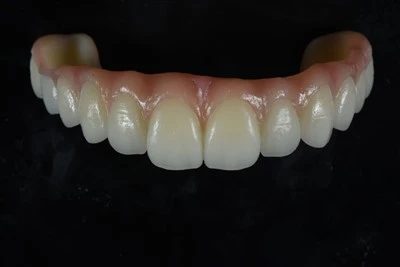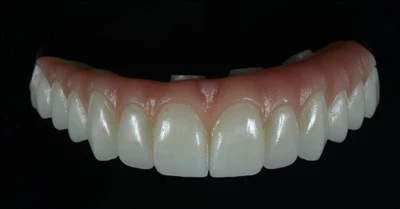
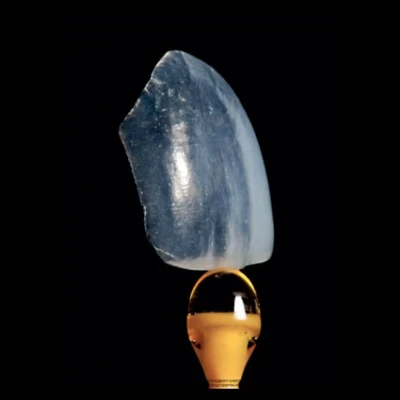
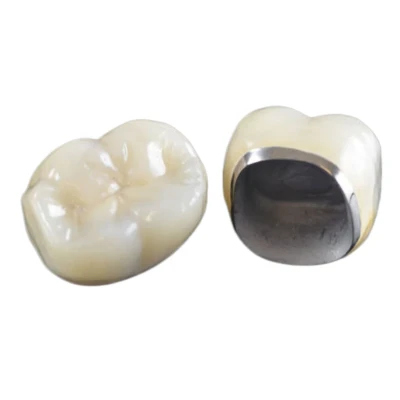
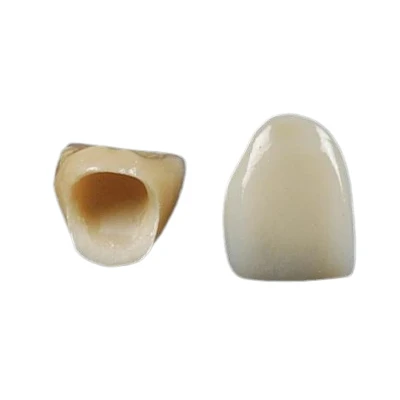
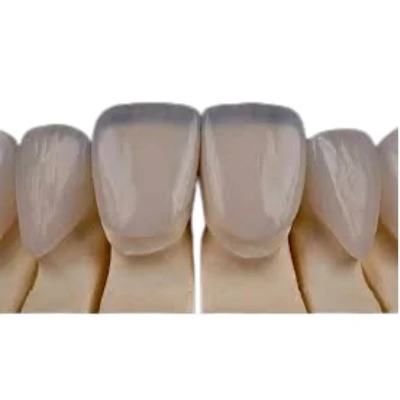
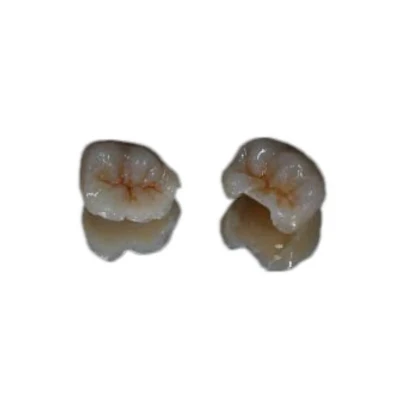

In anterior aesthetic work, the choice between feldspathic porcelain veneers and lithium disilicate (E.max) veneers comes up constantly. Clinicians want to know which one delivers the most convincing natural look when the goal is a seamless, lifelike smile-especially in low-stress front teeth where function takes a back seat to appearance.
Feldspathic veneers have held the position of gold standard for pure aesthetics for decades because of their optical behavior. E.max brings higher strength and easier predictability. There is no single winner across all cases, but for strictly aesthetic-driven anterior restorations, the scales tip toward feldspathic when the priority is maximum translucency and enamel-like light play.
What Are Feldspathic Veneers?
Feldspathic veneers are made from feldspathic porcelain, a glass-matrix ceramic built primarily around aluminosilicate with high glass content. The classic method involves hand-layering porcelain powders and liquids onto a refractory die or platinum foil, then firing multiple times to sinter each stratum. This process lets the technician build in gradual color transitions, opalescence, halo effects, and surface texture that closely match natural enamel-dentin interplay.
Modern versions use CAD/CAM-milled feldspathic blocks, which are pre-sintered and then hand-finished. These blocks allow ultra-thin designs-down to 0.3 mm or less in many cases-while keeping much of the translucency advantage.
The material's flexural strength sits in the 60–120 MPa range, depending on formulation and processing. That makes it brittle under heavy load, but in low-stress anterior zones with good bonding to enamel, clinical outcomes hold up well.
The real draw is optical performance. High glass content and layered construction create exceptional light transmission and diffusion that most other ceramics struggle to replicate at close range or under varied lighting.

What Are E.max Veneers?
E.max veneers use IPS e.max lithium disilicate, a glass-ceramic with roughly 70% needle-like lithium disilicate crystals in a glassy matrix. The crystals reinforce the structure, pushing flexural strength to around 360–530 MPa (depending on exact processing-Ivoclar lists up to 530 MPa for CAD versions after full crystallization).
Fabrication runs through CAD/CAM milling or hot-pressing. In CAD/CAM, the block mills in an intermediate "blue" phase (lithium metasilicate, machinable and about 130 MPa), then crystallizes in a furnace to reach final strength, shade, and translucency.
High-translucency (HT) ingots or blocks improve enamel mimicry, but the denser crystalline structure still makes the material appear slightly more opaque than pure feldspathic under critical inspection.
The strength allows thinner sections in some designs and better performance when masking discoloration or handling light occlusal contact. Prep typically needs 0.5–0.7 mm minimum to maintain integrity.

Feldspathic vs E.max Veneers: Key Differences
Translucency and natural appearance drive most aesthetic decisions.
Feldspathic leads here. The hand-layered approach (or hand-finished CAD versions) builds depth and light scattering that imitate enamel almost exactly-especially at incisal edges and in young, translucent teeth. E.max can look excellent with staining and glazing, but the monolithic or semi-monolithic nature limits nuanced optical gradients. Under natural or chairside lighting, many clinicians notice feldspathic appears more lifelike at close distances.
Strength flips the picture. E.max handles functional loads far better-ideal when patients have parafunction, bruxism tendencies, or need incisal extension. Feldspathic works reliably in protected anterior zones, but fracture risk rises if occlusal forces creep in.
Tooth preparation follows the same logic. Feldspathic often allows minimal reduction (0.3–0.5 mm, sometimes no-prep on sound enamel). E.max usually demands more space (0.5–0.7 mm) to avoid compromising strength.
Longevity data from recent meta-analyses shows both materials achieve high survival rates in veneer applications-around 95–96% at 10 years when properly indicated and bonded. Feldspathic fracture rates hover near 5%, E.max closer to 3–4% in some reviews, with E.max showing fewer overall technical and biological complications. In pure aesthetic cases with low stress, the difference narrows significantly.
Technical demands differ too. Feldspathic layering requires experienced ceramists to control shrinkage, color, and fit across firings. E.max monolithic design reduces variability and speeds production.
Comparison Table: Feldspathic vs E.max Veneers
|
Dimension |
Feldspathic Veneers |
E.max Veneers |
Impact on Pure Aesthetic Cases |
|
Material & Fabrication |
Hand-layered porcelain or CAD/CAM blocks + hand finish |
Lithium disilicate, CAD/CAM or pressed monolithic |
Feldspathic offers more artistic control |
|
Translucency / Natural Look |
Unmatched (enamel-like light diffusion) |
Good to high (HT versions strong, but denser) |
Feldspathic clearly superior |
|
Flexural Strength |
60–120 MPa |
360–530 MPa |
E.max far better for any functional demand |
|
Tooth Preparation Depth |
Minimal (0.3–0.5 mm, often ultra-thin) |
0.5–0.7 mm minimum |
Feldspathic more conservative |
|
10-Year Survival Rate |
~95% (low-stress zones reliable) |
~95–96% (fewer complications overall) |
Both strong; difference small in aesthetics |
|
Best Suited For |
Pure anterior aesthetics, minimal prep, complex characterization |
Strength priority, bruxism, discoloration masking |
Feldspathic preferred for max naturalness |
|
Technical / Lab Dependency |
High (skill in layering critical) |
Lower (monolithic more forgiving) |
- |
|
Cost (Lab Perspective) |
Higher for hand-layered |
Generally more efficient |
- |
This table highlights the trade-offs. In aesthetic-only scenarios, translucency and prep conservation usually outweigh raw strength.
When to Choose Feldspathic Veneers or E.max Veneers
Case selection boils down to priorities.
Choose feldspathic when:
- The main goal is the most convincing natural appearance-especially young patients, bleach shades, or incisal translucency.
- Minimal enamel removal is important (sound teeth, conservative philosophy).
- Complex polychromatic effects or surface texture replication are needed.
- You work with a lab that masters layering and has proven anterior aesthetic results.
Choose E.max when:
- Patient history includes grinding, clenching, or light occlusal contact.
- Dark underlying discoloration needs reliable masking.
- Prep extends deeper or covers incisal edges with functional risk.
- Workflow efficiency and consistency matter more than peak optical nuance.
In pure aesthetic anterior cases with healthy enamel and low bite forces, feldspathic still delivers the edge in perceived naturalness. Modern bonding and precision prep have made fragility concerns less dominant than they were 15 years ago.
How to Choose the Right Dental Lab
Material performance only goes as far as fabrication quality allows.
Look for a partner that handles both options well. Feldspathic needs technicians skilled in stratification, firing control, and characterization-mistakes show immediately in translucency or fit. E.max benefits from tight CAD/CAM tolerances and consistent crystallization.
At ADS Dental Laboratory Ltd, we focus on overseas clinicians who need reliable, long-term Dental Lab outsourcing. We run hand-layered feldspathic for maximum aesthetics and full CAD/CAM E.max for strength cases, often combining digital design with manual refinement. Color communication, prep verification, and turnaround stay consistent because we built the process around repeat B2B work.
If you send models, photos, or shade references, we can discuss which material fits the case and provide quick feedback or quotes.
Conclusion: Feldspathic or E.max?
For strictly aesthetic anterior cases, feldspathic veneers remain the go-to when the objective is the closest match to natural enamel optics. The layered translucency and minimal prep give results that are hard to beat visually.
E.max holds its place when strength or predictability becomes non-negotiable-bruxism, deeper prep, or masking needs tip the balance.
The material matters, but execution decides the outcome. Partner with a lab that understands both and can deliver consistently, and either option can produce excellent, lasting work.
If you're planning an aesthetic case and want to talk through material selection or get a no-obligation review of your prep/photos, reach out. We're here to help make the decision straightforward.